You’re under arrest and your phone is right there in your pocket. Can the officer scroll through it? Riley v. California is the Supreme Court’s flat answer — and it’s the rule your whole digital life rides on.
What did Riley v. California decide?
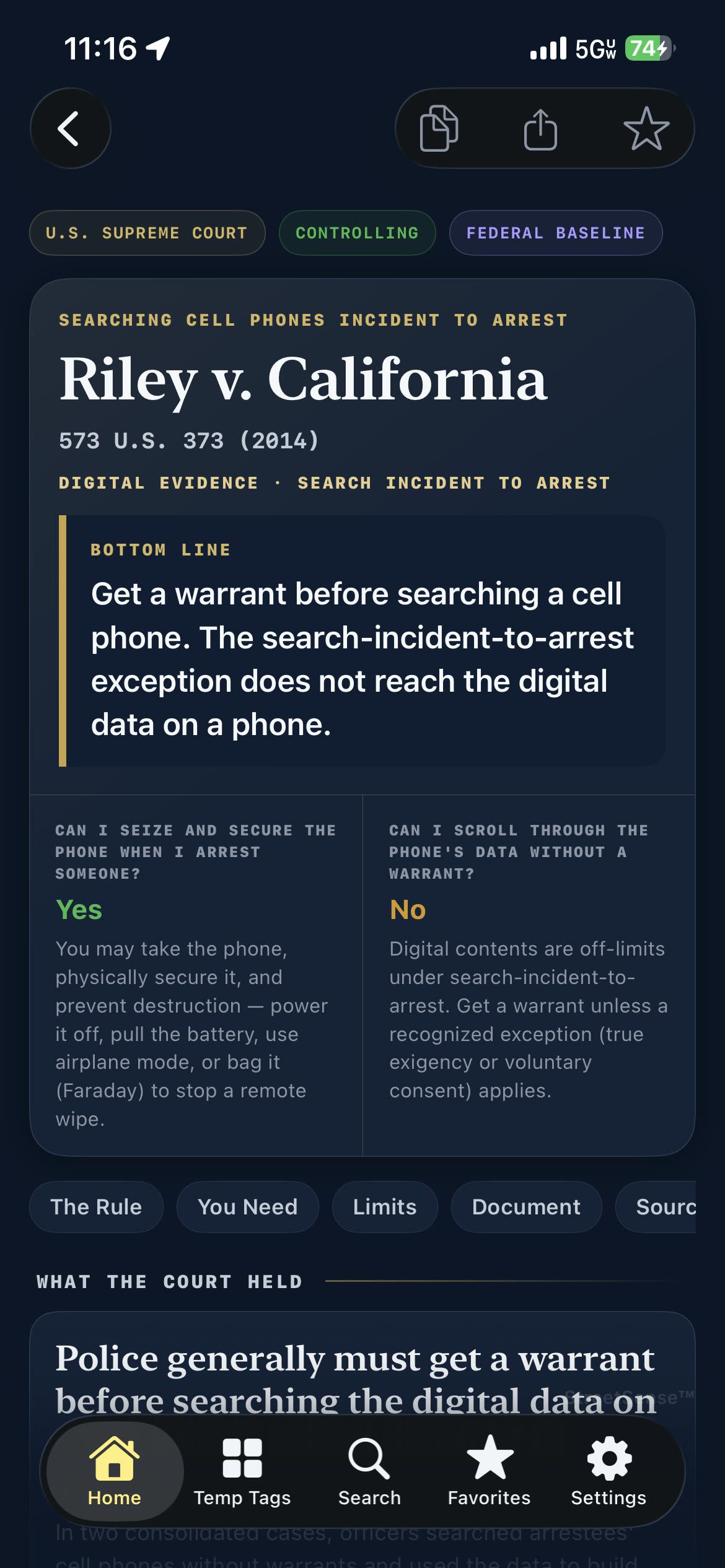
The search-incident-to-arrest doctrine does not reach the digital data on a cell phone. Officers may seize and secure the phone, but searching its contents generally requires a warrant — unless a true exigency or valid consent applies.
Riley v. California, 573 U.S. 373 (2014) — read the opinion on CourtListener.
What does Riley v. California allow?
- Seizing the phone during a lawful arrest
- Securing it against remote wiping — powering it off, airplane mode, or a Faraday bag
What does it NOT allow?
- No scrolling or searching the data without a warrant
- Exceptions are narrow: a genuine emergency (exigent circumstances) or voluntary consent
How it plays out on the street
Riley draws the modern line between the physical and digital person: the phone’s body follows Robinson, the phone’s data follows the warrant clause. Seize now, search on paper.
Frequently asked questions
Can police look through your phone when they arrest you?
Generally no. Riley v. California requires a warrant to search a phone’s data, even after a lawful arrest.
Can police take the phone itself?
Yes — seizing and securing the phone during arrest is allowed; it’s the data search that needs a warrant.
Are there exceptions to the Riley warrant rule?
A true emergency (exigent circumstances) or voluntary consent can justify a warrantless search.
Related cases
- U.S. v. Robinson (1973): How Far Can a Search Go After an Arrest?
- Arizona v. Gant (2009): Can Police Search Your Car After You’re Arrested?
- Kentucky v. King (2011): Knock at the Door, Sounds of Evidence Being Destroyed
Carry the rule, not the guesswork. Every case in StreetSense is broken down like this — bottom line, limits, and the exact citation — verified against the real opinion and available fully offline on shift. Start the free trial.
StreetSense is an educational reference for law enforcement, not legal advice. Federal cases set the floor — your state constitution, statutes, and department policy can impose stricter limits. Always follow your state’s rule and your agency’s policy.
Spot an error? Email nick@mnsindustriesllc.com with the post and your source. Corrections to the app go out over the air. How we verify.