The driver got pulled over — not you. So can the officer make you get out too? Maryland v. Wilson extended the Mimms rule from drivers to everyone in the car.
What did Maryland v. Wilson decide?
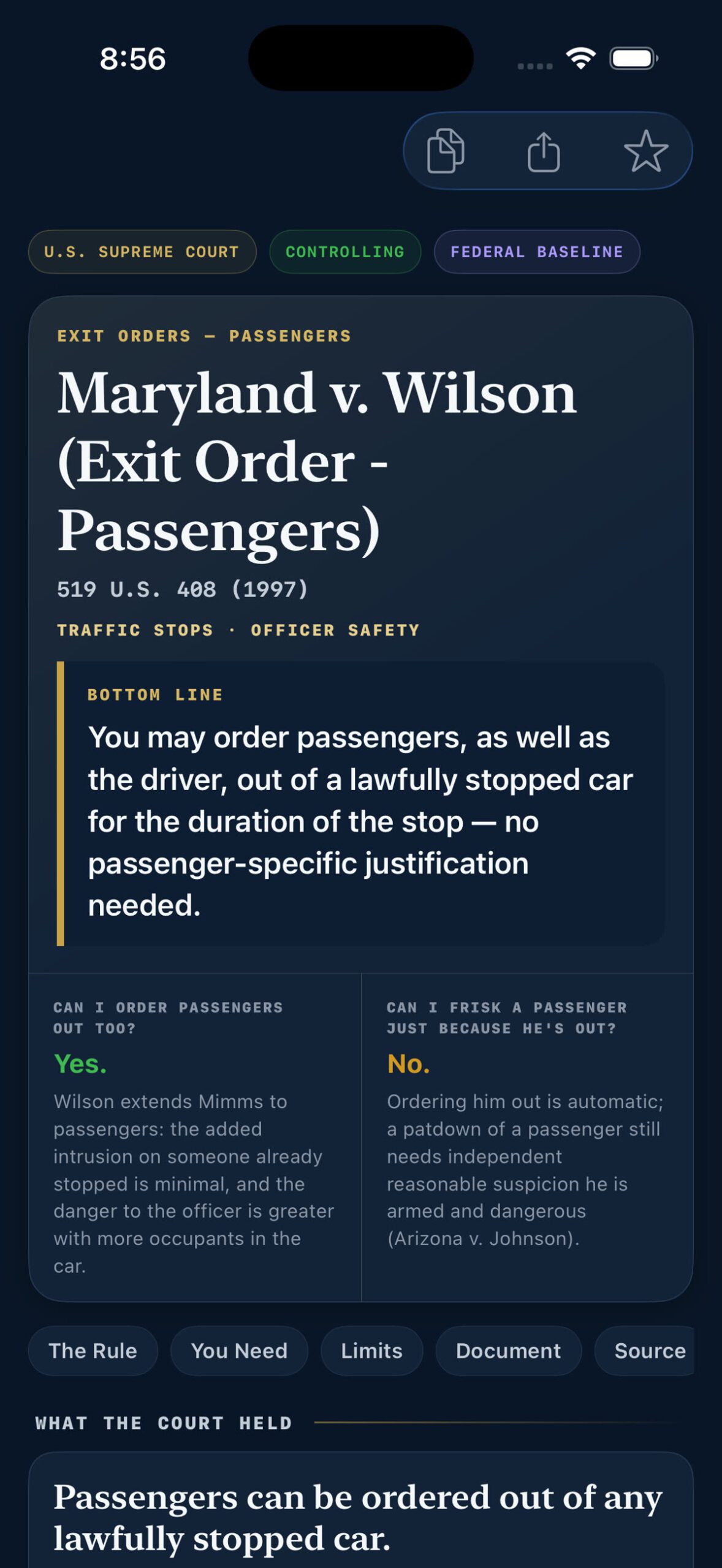
During a lawful traffic stop, officers may order passengers out of the vehicle for the duration of the stop, just like the driver — no passenger-specific justification needed. The Court reasoned the added intrusion on someone already stopped is minimal, while the danger to the officer grows with more occupants.
Maryland v. Wilson, 519 U.S. 408 (1997) — read the opinion on CourtListener.
What does Maryland v. Wilson allow?
- Ordering any passenger out of a lawfully stopped vehicle, automatically
- Keeping passengers out for the duration of the stop
What does it NOT allow?
- It does not authorize frisking a passenger — that still needs independent reasonable suspicion they’re armed and dangerous
- It does not extend the stop’s length or scope; the stop’s mission still controls
How it plays out on the street
Wilson pairs with Mimms as the exit-order rule for the whole car. The trap is treating “out of the car” as “hands on the hood” — the pat-down is a separate legal event with its own standard.
Frequently asked questions
Do passengers have to get out if ordered during a traffic stop?
Yes. Maryland v. Wilson lets officers order passengers out of a lawfully stopped car automatically.
Can the officer pat down a passenger who was ordered out?
Not automatically. A frisk requires its own reasonable suspicion that the passenger is armed and dangerous.
Are passengers ‘seized’ during a traffic stop?
Yes — Brendlin v. California holds passengers are seized from the moment the car stops, which gives them standing to challenge the stop.
Related cases
- Pennsylvania v. Mimms (1977): Can Police Order the Driver Out of the Car?
- Brendlin v. California (2007): Can a Passenger Challenge a Bad Traffic Stop?
- U.S. v. Robinson (1973): How Far Can a Search Go After an Arrest?
Carry the rule, not the guesswork. Every case in StreetSense is broken down like this — bottom line, limits, and the exact citation — verified against the real opinion and available fully offline on shift. Start the free trial.
StreetSense is an educational reference for law enforcement, not legal advice. Federal cases set the floor — your state constitution, statutes, and department policy can impose stricter limits. Always follow your state’s rule and your agency’s policy.
Spot an error? Email nick@mnsindustriesllc.com with the post and your source. Corrections to the app go out over the air. How we verify.