Police knock on a door — no warrant, just a knock — and inside someone starts scrambling to destroy evidence. Can they force entry? Kentucky v. King draws the line between a lawful knock and a police-manufactured emergency.
What did Kentucky v. King decide?
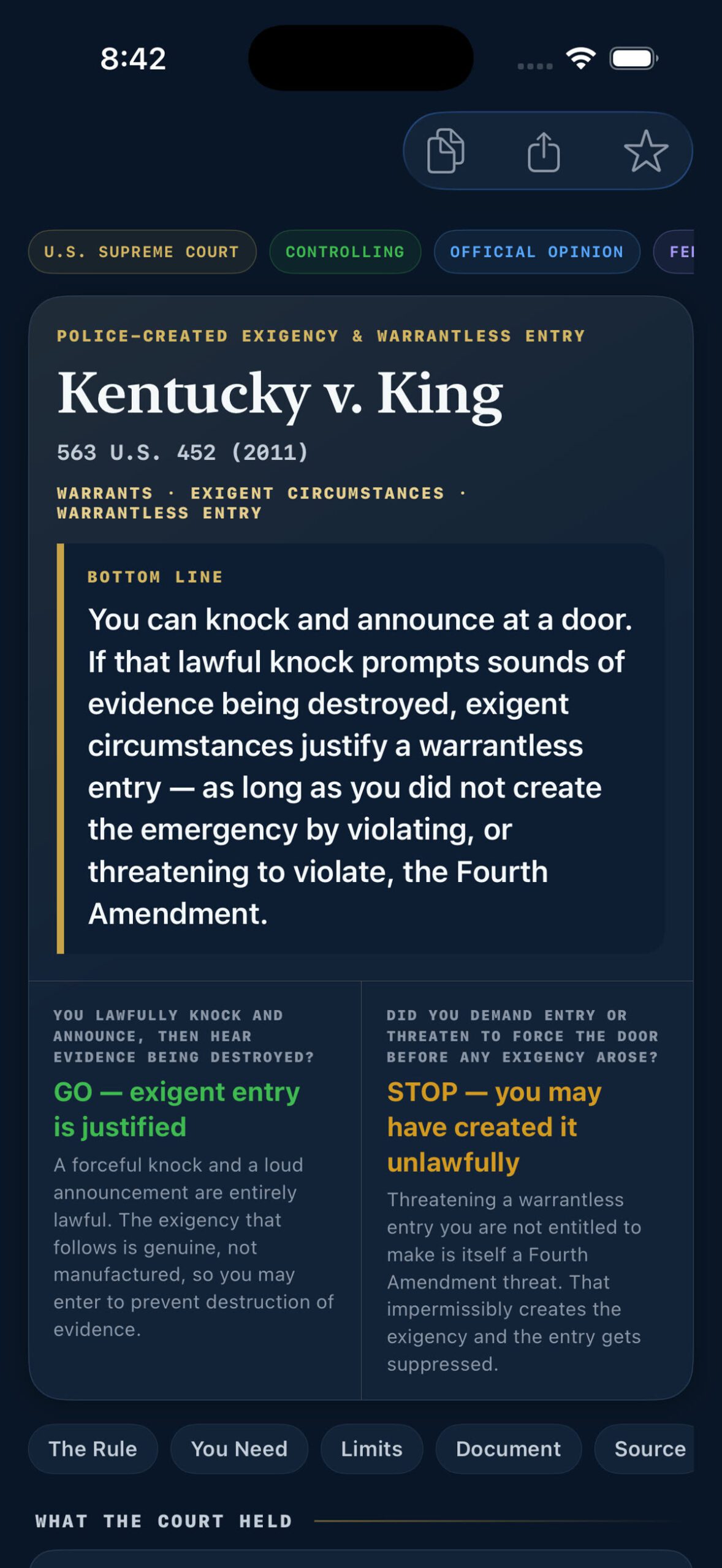
Officers may knock and announce at a door like anyone else. If that lawful conduct prompts an exigency — such as the sounds of evidence being destroyed — warrantless entry is justified, so long as the police did not create the exigency by violating or threatening to violate the Fourth Amendment.
Kentucky v. King, 563 U.S. 452 (2011) — read the opinion on CourtListener.
What does Kentucky v. King allow?
- Knock-and-talk at a door without a warrant
- Warrantless entry when a genuine exigency arises from lawful police conduct
What does it NOT allow?
- Police-created exigency is fatal: demanding entry or threatening to force the door before any emergency exists taints the entry
- The underlying exigency must be real — generalized possibilities aren’t enough
How it plays out on the street
King rewards patience and punishes shortcuts: the knock is free, but a single ‘open up or we’re coming in’ before the emergency exists can convert a good entry into a suppressed one.

Frequently asked questions
Can police enter without a warrant if they hear evidence being destroyed?
Yes — if the exigency is genuine and arose from lawful police conduct like a knock-and-announce, Kentucky v. King permits warrantless entry.
What is a police-created exigency?
An emergency the officers themselves caused by violating or threatening to violate the Fourth Amendment — for example, threatening to break the door down before any exigency existed. That entry gets suppressed.
Related cases
- Lange v. California (2021): Can Police Follow a Fleeing Misdemeanor Suspect Into a Home?
- Utah v. Strieff (2016): Illegal Stop, Old Warrant — Does the Evidence Survive?
- Riley v. California (2014): Can Police Search Your Phone After an Arrest?
Carry the rule, not the guesswork. Every case in StreetSense is broken down like this — bottom line, limits, and the exact citation — verified against the real opinion and available fully offline on shift. Start the free trial.
StreetSense is an educational reference for law enforcement, not legal advice. Federal cases set the floor — your state constitution, statutes, and department policy can impose stricter limits. Always follow your state’s rule and your agency’s policy.
Spot an error? Email nick@mnsindustriesllc.com with the post and your source. Corrections to the app go out over the air. How we verify.