You’re just the passenger. The stop was bogus and the driver did nothing wrong — but the officer finds something on you. Can you even contest the stop? Brendlin v. California: yes.
What did Brendlin v. California decide?
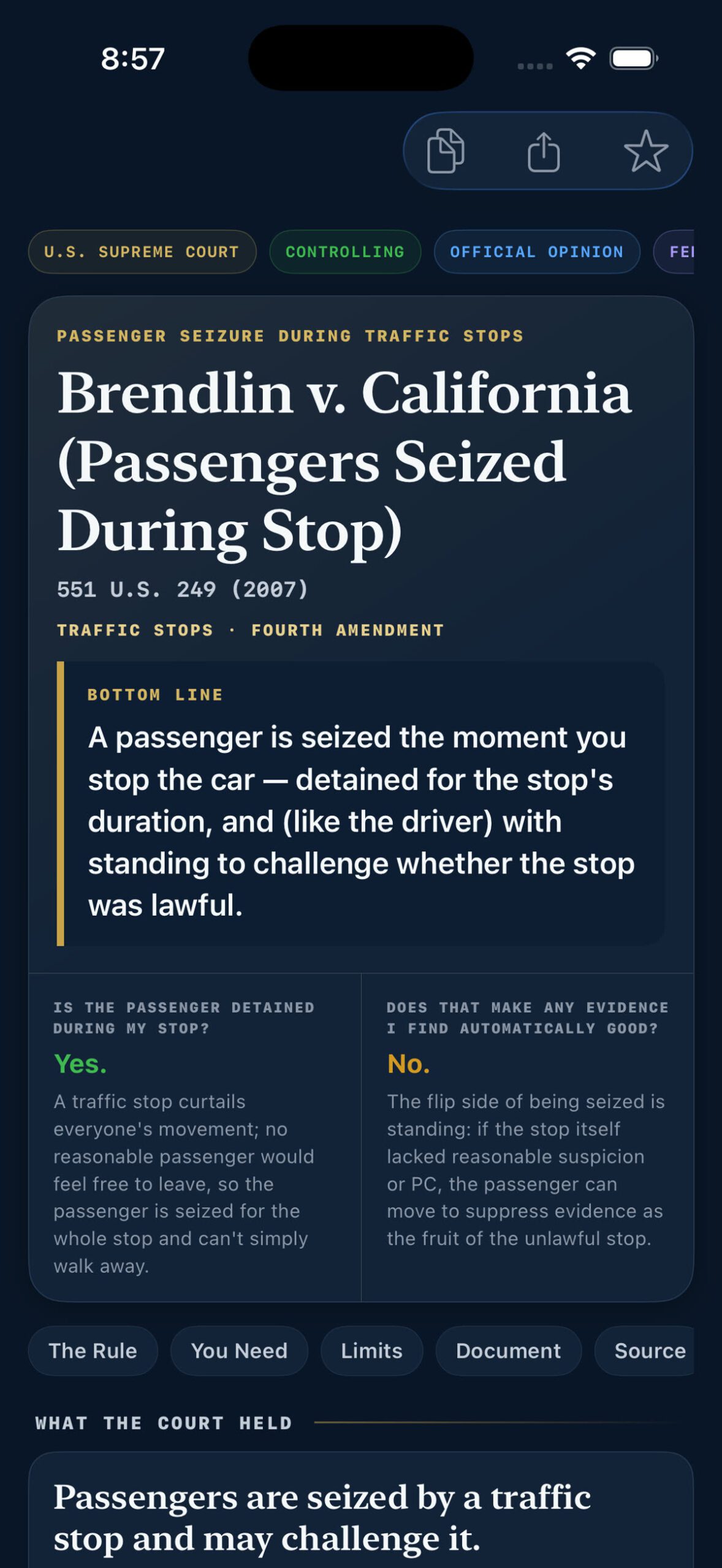
When police stop a car, every occupant — passengers included — is seized for Fourth Amendment purposes from the moment the car stops. That seizure gives passengers standing to challenge the lawfulness of the stop, and evidence flowing from an unlawful stop can be suppressed as its fruit.
Brendlin v. California, 551 U.S. 249 (2007) — read the opinion on CourtListener.
What does Brendlin v. California allow?
- Passengers may litigate whether the stop itself was lawful
- Suppression of evidence found on a passenger as fruit of an unlawful stop, subject to doctrines like attenuation
What does it NOT allow?
- It does not make stops unlawful — it decides who may complain about one
- A lawful stop still permits exit orders (Wilson) and everything else the stop lawfully allows
How it plays out on the street
Brendlin closed the “passengers can’t complain” loophole. Every occupant in the car is a potential suppression motion — the stop’s justification has to hold for all of them.

Frequently asked questions
Are passengers seized during a traffic stop?
Yes. Brendlin v. California holds every occupant is seized the moment the car is stopped.
Can a passenger get evidence suppressed after a bad stop?
If the stop was unlawful, evidence found as its fruit can be suppressed — subject to exceptions like attenuation (Utah v. Strieff).
Related cases
- Maryland v. Wilson (1997): Can Police Order Passengers Out of the Car?
- Utah v. Strieff (2016): Illegal Stop, Old Warrant — Does the Evidence Survive?
- Pennsylvania v. Mimms (1977): Can Police Order the Driver Out of the Car?
Carry the rule, not the guesswork. Every case in StreetSense is broken down like this — bottom line, limits, and the exact citation — verified against the real opinion and available fully offline on shift. Start the free trial.
StreetSense is an educational reference for law enforcement, not legal advice. Federal cases set the floor — your state constitution, statutes, and department policy can impose stricter limits. Always follow your state’s rule and your agency’s policy.
Spot an error? Email nick@mnsindustriesllc.com with the post and your source. Corrections to the app go out over the air. How we verify.