The stop was illegal — no real suspicion at all. But the check turns up a valid arrest warrant, and the search after that arrest turns up drugs. Thrown out? Utah v. Strieff says: not necessarily.
What did Utah v. Strieff decide?
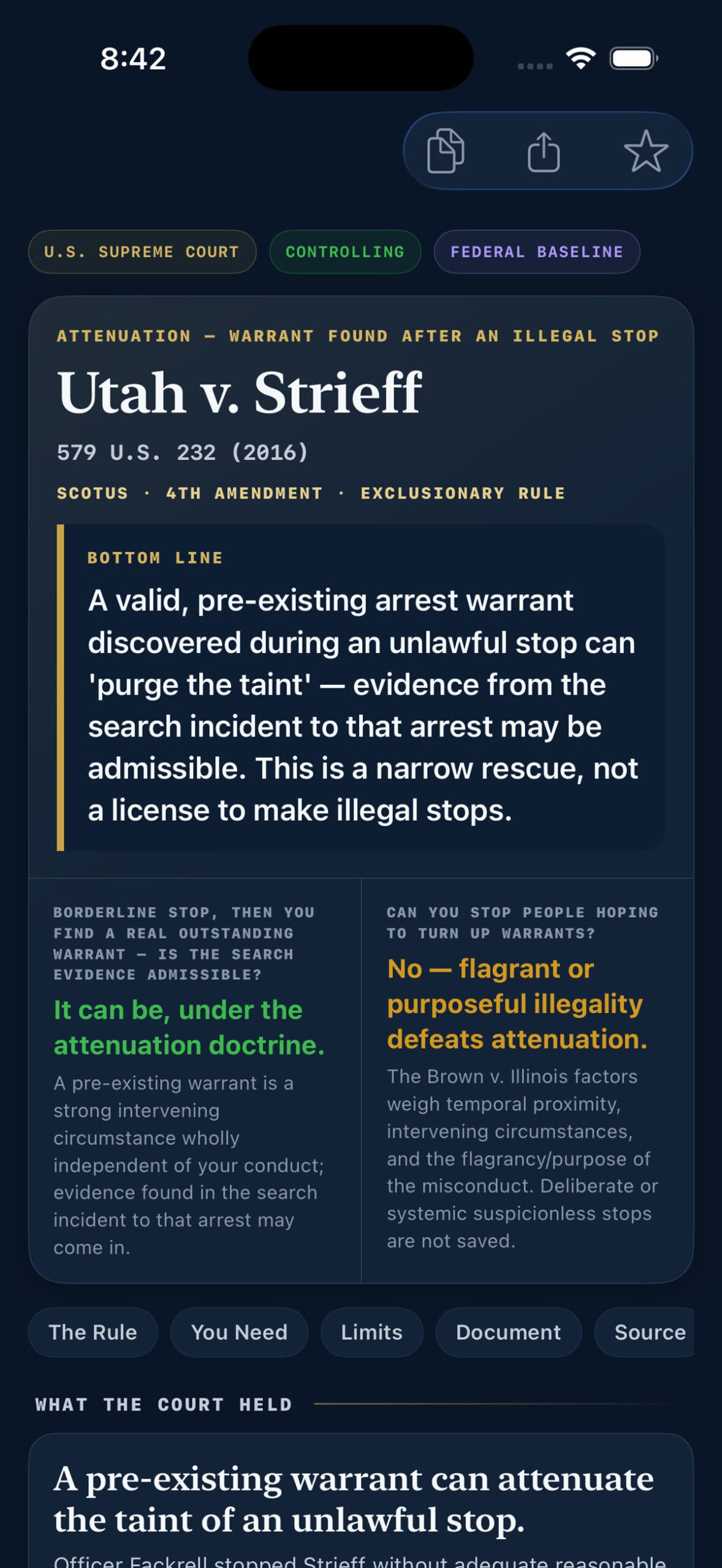
A valid, pre-existing arrest warrant discovered during an unlawful stop can be an intervening circumstance that attenuates — ‘purges the taint’ of — the illegal stop, letting evidence from the search incident to that arrest in. It is a narrow rescue governed by the attenuation factors, not a license.
Utah v. Strieff, 579 U.S. 232 (2016) — read the opinion on CourtListener.
What does Utah v. Strieff allow?
- Admitting evidence found after a valid pre-existing warrant is discovered and executed, when the attenuation factors are met
What does it NOT allow?
- Flagrant or purposeful illegality defeats attenuation — stops made hoping to turn up warrants get suppressed
- The warrant must be valid and pre-existing; the doctrine repairs nothing else about a bad stop
How it plays out on the street
Strieff is famously double-edged: it saved one search and simultaneously warned that systematic warrant-fishing is exactly what courts will punish. The officer’s purpose is on trial as much as the stop.
Frequently asked questions
Does an old arrest warrant make an illegal stop legal?
No — the stop stays unlawful. Strieff only lets the evidence in through attenuation when the warrant is valid, pre-existing, and the misconduct wasn’t flagrant.
What kills the Strieff rescue?
Flagrant, purposeful illegality — like stopping people specifically hoping to find warrants.
Related cases
- Brendlin v. California (2007): Can a Passenger Challenge a Bad Traffic Stop?
- Arizona v. Gant (2009): Can Police Search Your Car After You’re Arrested?
- Kentucky v. King (2011): Knock at the Door, Sounds of Evidence Being Destroyed
Carry the rule, not the guesswork. Every case in StreetSense is broken down like this — bottom line, limits, and the exact citation — verified against the real opinion and available fully offline on shift. Start the free trial.
StreetSense is an educational reference for law enforcement, not legal advice. Federal cases set the floor — your state constitution, statutes, and department policy can impose stricter limits. Always follow your state’s rule and your agency’s policy.
Spot an error? Email nick@mnsindustriesllc.com with the post and your source. Corrections to the app go out over the air. How we verify.