

The ticket’s written. Instead of cutting them loose, you hold them a few more minutes to walk the dog around the car. Rodriguez v. United States says those few minutes can sink the whole search.
What did Rodriguez v. United States decide?
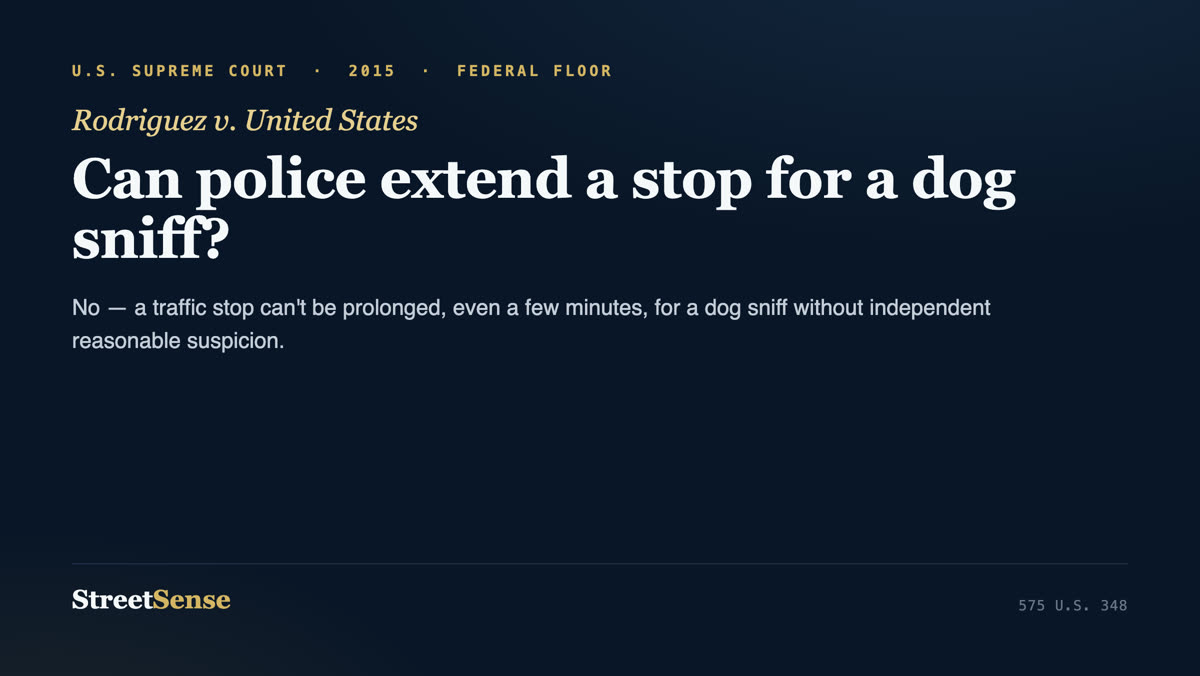
A traffic stop may last only as long as reasonably needed to complete its mission — the violation plus ordinary inquiries like license, registration, insurance, and a warrant check. Absent independent reasonable suspicion, police may not extend the stop at all — not even briefly — to conduct a dog sniff.
Rodriguez v. United States, 575 U.S. 348 (2015) — read the opinion on CourtListener.
What does Rodriguez v. United States allow?
- Handling the stop’s ordinary tasks: license, registration, insurance, and running warrants
- A dog sniff that doesn’t add time to the stop, done during its normal course (see Illinois v. Caballes)
- Extending the stop if independent reasonable suspicion of another crime develops during it
What does it NOT allow?
- Adding time to an otherwise-completed stop for a dog sniff without reasonable suspicion — even 7–8 minutes
- Relying on a ‘de minimis’ cushion of free time; there is none — the mission sets the clock
How it plays out on the street
The stopwatch is the mission, not the ticket. Once you’ve reasonably handled the violation and the ordinary checks, your authority to hold them is spent unless you’ve built independent reasonable suspicion first. Articulate — and document — the suspicion that existed before you extended the stop, not after. This is the federal floor; your state may hold you to a stricter standard.
Frequently asked questions
Can I run a dog around the car during a traffic stop?
Yes, as long as it doesn’t prolong the stop beyond the time reasonably needed to handle the violation. You cannot hold the driver extra to wait on the dog without independent reasonable suspicion.
How long can a traffic stop last?
Only as long as reasonably needed to complete the stop’s mission — the violation plus ordinary checks like license, registration, and warrants. There is no fixed number of minutes; the tasks define the limit.
Related cases
- Terry v. Ohio: Reasonable Suspicion on Every Traffic Stop
- Brendlin v. California (2007): Can a Passenger Challenge a Bad Stop?
- Heien v. North Carolina (2014): Does a Cop’s Mistake of Law Ruin the Stop?
Carry the rule, not the guesswork. Every case in StreetSense is broken down like this — bottom line, limits, and the exact citation — verified against the real opinion and available fully offline on shift. Start the free trial.
StreetSense is an educational reference for law enforcement, not legal advice. Federal cases set the floor — your state constitution, statutes, and department policy can impose stricter limits. Always follow your state’s rule and your agency’s policy.