
You stop a car for a burned-out brake light — then learn the statute only requires one working light. Bad stop? Heien v. North Carolina says: not if your read of an ambiguous law was reasonable.
What did Heien v. North Carolina decide?
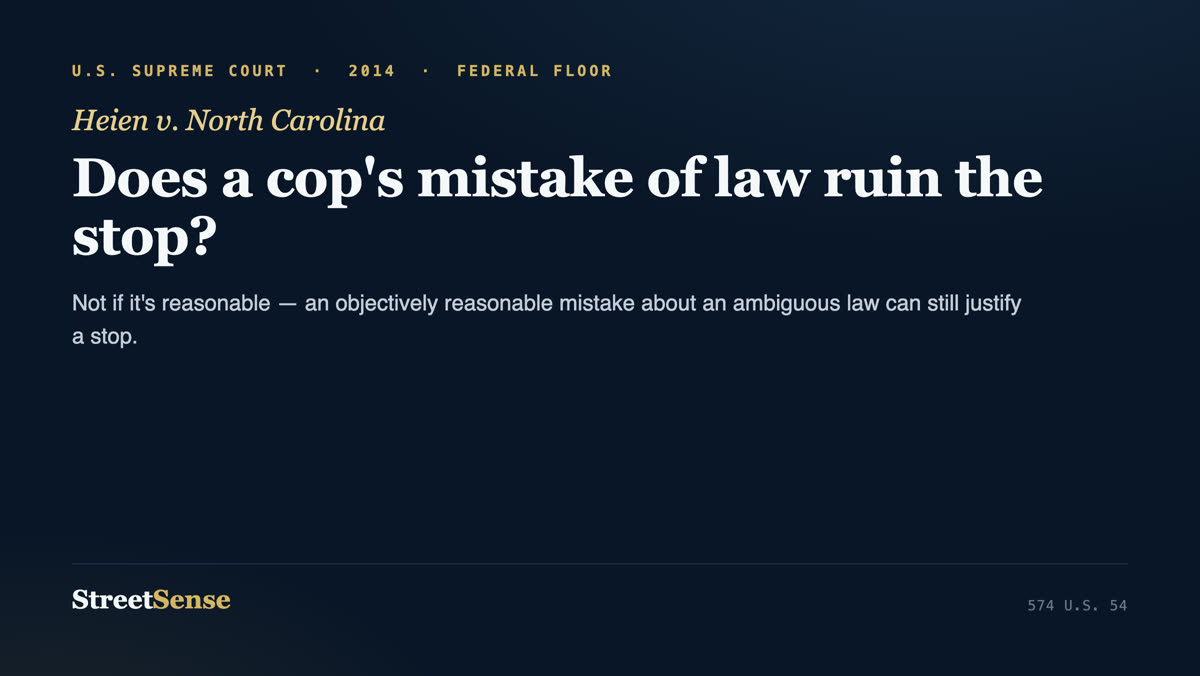
Reasonable suspicion can rest on a reasonable mistake of law, not just a mistake of fact. If an officer’s misunderstanding of a genuinely ambiguous statute is objectively reasonable, it can still supply the reasonable suspicion needed for a stop. The mistake must be objectively reasonable — not merely sincere.
Heien v. North Carolina, 574 U.S. 54 (2014) — read the opinion on CourtListener.
What does Heien v. North Carolina allow?
- Reasonable suspicion built on an objectively reasonable reading of an unclear, unsettled statute
- Upholding the stop where the law was genuinely ambiguous and had not yet been construed
What does it NOT allow?
- Sloppy or unreasonable mistakes — ignorance of clear, settled law will not save a stop
- Treating ‘I thought it was illegal’ as a blanket cover; reasonableness is judged objectively, not by the officer’s say-so
How it plays out on the street
This one cuts both ways: it forgives a genuinely close call on an ambiguous statute, but it is not a license to be wrong about settled law. And it’s only the federal floor — several states reject Heien and require an actual violation, while others follow it (New York adopts it via People v. Guthrie). Know which rule your state applies before you lean on a shaky read of the code.
Frequently asked questions
If an officer is wrong about the law, is the stop automatically bad?
Not under Heien. A reasonable mistake about a genuinely ambiguous law can still justify the stop. An unreasonable mistake about clear, settled law cannot.
Does every state follow Heien?
No. Heien is the federal floor. Some states require an actual violation of the law and reject reasonable mistakes of law; others follow Heien. Check your state’s rule.
Related cases
- Terry v. Ohio: Reasonable Suspicion on Every Traffic Stop
- Probable Cause vs. Reasonable Suspicion
- Rodriguez v. United States (2015): Can Police Extend a Stop for a Dog Sniff?
Carry the rule, not the guesswork. Every case in StreetSense is broken down like this — bottom line, limits, and the exact citation — verified against the real opinion and available fully offline on shift. Start the free trial.
StreetSense is an educational reference for law enforcement, not legal advice. Federal cases set the floor — your state constitution, statutes, and department policy can impose stricter limits. Always follow your state’s rule and your agency’s policy.