

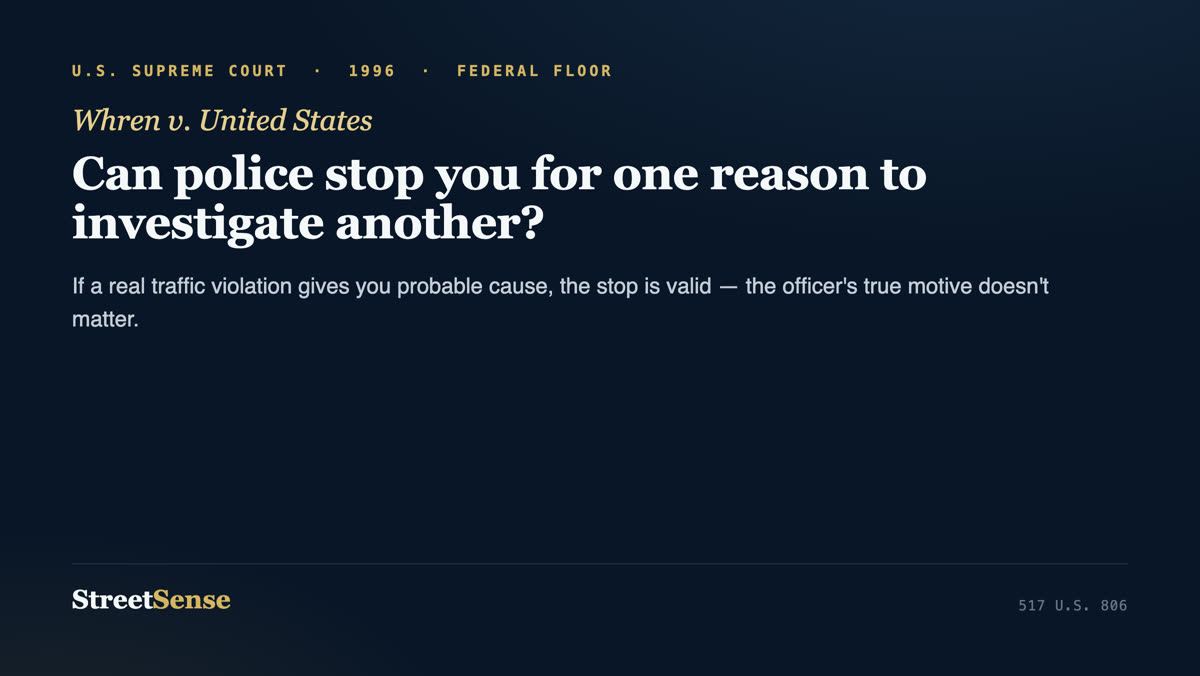
You stop a car for failing to signal — but what you really want is a look at the driver. Whren v. United States says: if the traffic violation was real, your motive doesn’t matter.
What did Whren v. United States decide?
When police have probable cause that a traffic violation occurred, the stop is reasonable under the Fourth Amendment regardless of the officer’s actual, subjective motivation. Ulterior motives don’t invalidate conduct that is objectively justified.
Whren v. United States, 517 U.S. 806 (1996) — read the opinion on CourtListener.
What does Whren allow?
- Stopping a vehicle when you have an objective basis — a real, articulable traffic violation — even if that violation is a pretext for other investigation
- Acting on that objective justification regardless of your subjective intent
What does it NOT allow?
- A stop with no actual violation and no objective justification
- Selecting who to stop based on race or another protected characteristic — that’s an Equal Protection violation Whren does not excuse
How it plays out on the street
Whren is why ‘pretext stop’ isn’t a Fourth Amendment loser — but it’s not a blank check. The violation has to be real and articulable, and selective enforcement by race is challenged under the Equal Protection Clause, not the Fourth. This is the federal floor: some states reject Whren under their own constitutions and require a genuine purpose — know your state’s rule.
Frequently asked questions
Does it matter why I really stopped the car?
Not for the Fourth Amendment. Under Whren, if you had an objective basis — a real traffic violation — the stop is valid regardless of your motive.
So pretext stops are always legal?
Not necessarily. Whren is the federal rule; some state constitutions reject it. And a stop based on race raises an Equal Protection problem Whren doesn’t excuse.
Related cases
- Heien v. North Carolina (2014): Does a Cop’s Mistake of Law Ruin the Stop?
- Terry v. Ohio: Reasonable Suspicion on Every Traffic Stop
- Kansas v. Glover (2020): Can Police Stop a Car Because the Owner’s License Is Revoked?
Carry the rule, not the guesswork. Every case in StreetSense is broken down like this — bottom line, limits, and the exact citation — verified against the real opinion and available fully offline on shift. Start the free trial.
StreetSense is an educational reference for law enforcement, not legal advice. Federal cases set the floor — your state constitution, statutes, and department policy can impose stricter limits. Always follow your state’s rule and your agency’s policy.