
You run a plate. The registered owner’s license is revoked. Can you stop the car without knowing who’s behind the wheel? Kansas v. Glover says yes — with a catch.
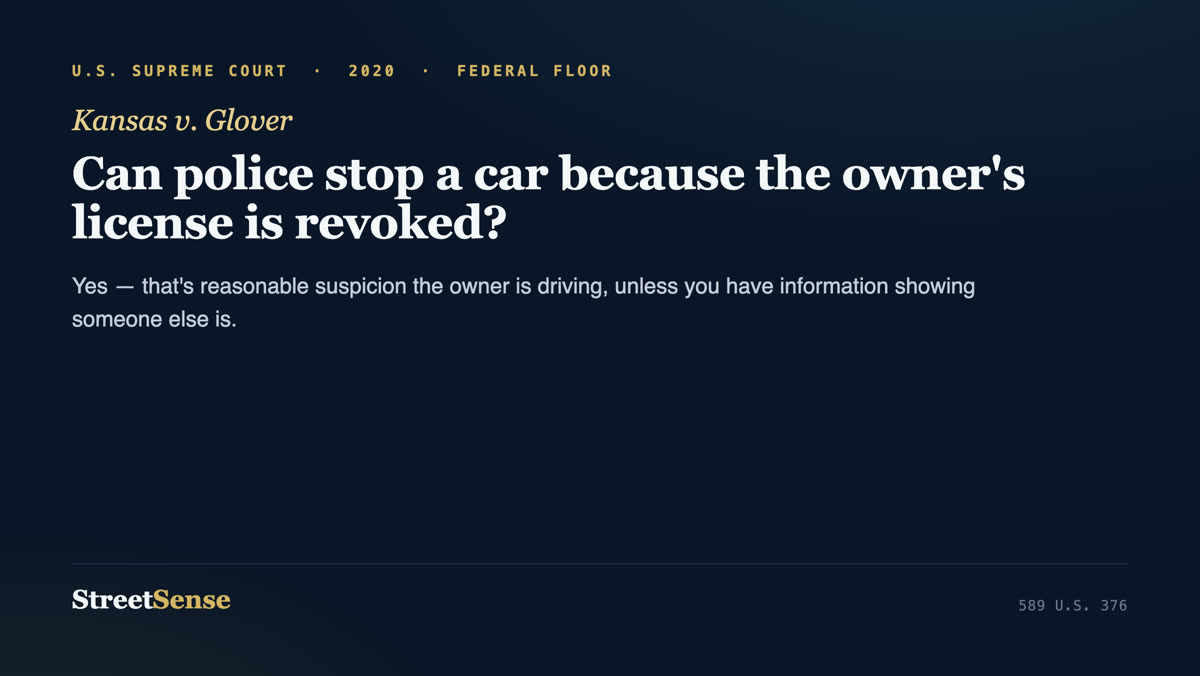
What did Kansas v. Glover decide?
When an officer lacks information negating the inference that the owner is driving, a plate check showing the registered owner’s license is revoked provides reasonable suspicion to stop the vehicle. It’s a common-sense inference, not a certainty.
Kansas v. Glover, 589 U.S. 376 (2020) — read the opinion on CourtListener.
What does Glover allow?
- Stopping the vehicle on reasonable suspicion that the owner — whose license is revoked or suspended — is the driver
- Relying on the plate return absent contrary information
What does it NOT allow?
- Continuing the inference once you have information dispelling it — e.g., the driver is plainly a different age or sex than the registered owner
- Stretching the inference when you already know the owner isn’t driving
How it plays out on the street
Running plates is the bread and butter, and Glover blesses the stop — but the inference collapses the moment you can see the driver doesn’t match the owner. If dispatch or your own eyes tell you it’s not the owner, the reasonable suspicion is gone. Federal floor; your state may demand more.
Frequently asked questions
Can I stop a car just because the owner’s license is revoked?
Yes, under Glover — that’s reasonable suspicion the owner is driving, unless you have information showing someone else is behind the wheel.
What kills the Glover inference?
Anything showing the driver isn’t the owner — for example, the driver is obviously a different age or sex than the registered owner. Then the reasonable suspicion disappears.
Related cases
- Whren v. United States (1996): Can Police Stop You for One Reason to Investigate Another?
- Terry v. Ohio: Reasonable Suspicion on Every Traffic Stop
- Navarette v. California (2014): Can an Anonymous 911 Call Justify a Stop?
Carry the rule, not the guesswork. Every case in StreetSense is broken down like this — bottom line, limits, and the exact citation — verified against the real opinion and available fully offline on shift. Start the free trial.
StreetSense is an educational reference for law enforcement, not legal advice. Federal cases set the floor — your state constitution, statutes, and department policy can impose stricter limits. Always follow your state’s rule and your agency’s policy.