You commit a minor traffic offense, keep driving, and pull into your own garage — and the officer walks in behind you. No warrant. Lange v. California is the Supreme Court’s modern answer.
What did Lange v. California decide?
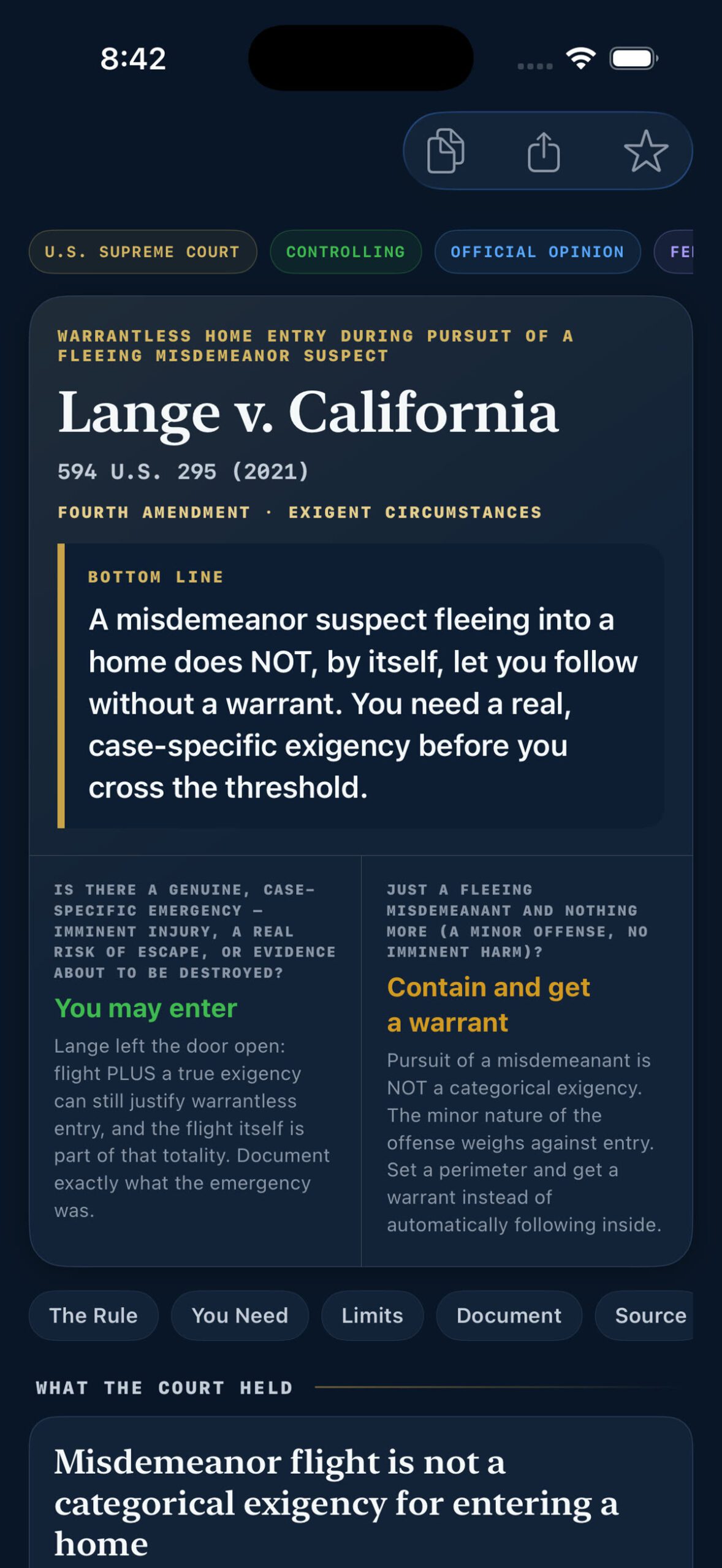
Pursuit of a fleeing misdemeanor suspect does not, by itself, justify warrantless entry into a home. There is no categorical misdemeanor-pursuit exigency: entry requires a genuine, case-specific emergency — imminent harm, imminent destruction of evidence, or a true escape risk — assessed on the totality.
Lange v. California, 594 U.S. 295 (2021) — read the opinion on CourtListener.
What does Lange v. California allow?
- Warrantless entry when flight is paired with a real, articulable emergency on the facts of the case
What does it NOT allow?
- Flight from a minor offense alone does not open the door
- No emergency means contain the scene and get a warrant
- The home keeps the strongest Fourth Amendment protection — thresholds matter
How it plays out on the street
Lange forces the question every pursuing officer must answer at the doorway: what exactly is the emergency, in this case, right now? Document it — ‘he ran’ is not enough on its own.
Frequently asked questions
Can police always follow someone into a house during a chase?
No. For misdemeanors, Lange requires a genuine case-specific emergency — flight alone doesn’t justify warrantless home entry.
What counts as an emergency under Lange?
Imminent injury to someone, imminent destruction of evidence, or a genuine risk of escape — judged on the specific facts.
What should officers do without an emergency?
Set a perimeter, contain the scene, and get a warrant.
Related cases
- Kentucky v. King (2011): Knock at the Door, Sounds of Evidence Being Destroyed
- Riley v. California (2014): Can Police Search Your Phone After an Arrest?
- Arizona v. Gant (2009): Can Police Search Your Car After You’re Arrested?
Carry the rule, not the guesswork. Every case in StreetSense is broken down like this — bottom line, limits, and the exact citation — verified against the real opinion and available fully offline on shift. Start the free trial.
StreetSense is an educational reference for law enforcement, not legal advice. Federal cases set the floor — your state constitution, statutes, and department policy can impose stricter limits. Always follow your state’s rule and your agency’s policy.
Spot an error? Email nick@mnsindustriesllc.com with the post and your source. Corrections to the app go out over the air. How we verify.