A welfare check, a concerned spouse, and firearms in the house. Does caretaking get you in the door? Caniglia v. Strom says find another justification.
What did Caniglia v. Strom decide?
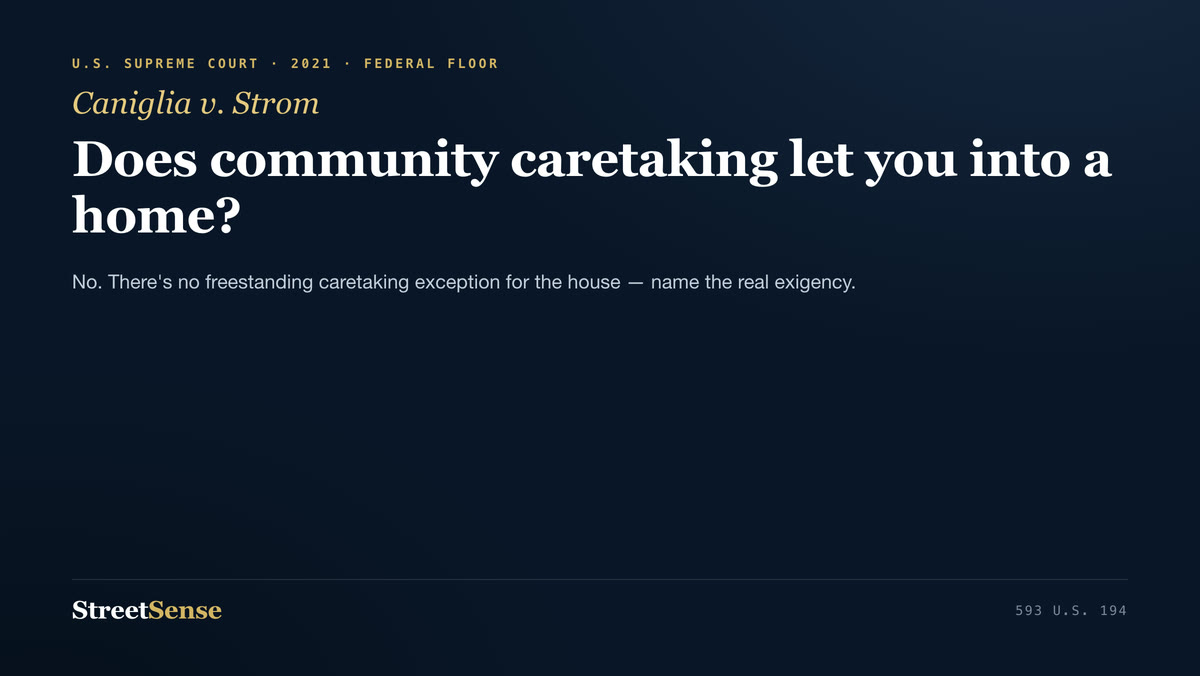
There is no freestanding community-caretaking exception to the warrant requirement that justifies a warrantless entry into a home or a warrantless seizure of property inside it. The caretaking rationale recognized for vehicles in Cady v. Dombrowski does not extend to the home.
Caniglia v. Strom, 593 U.S. 194 (2021) — read the opinion on CourtListener.
What does Caniglia allow?
- Entry on genuine exigency, including emergency aid — an objectively reasonable basis to believe someone inside needs immediate assistance
- Entry on valid consent from someone with authority, or with a warrant
- Caretaking functions involving vehicles, which Cady addressed and Caniglia left alone
- Using your state’s red-flag or extreme-risk protective order process, which is a separate legal path with its own procedure
What does it NOT allow?
- Entering a home on a general welfare-check or community-caretaking theory with nothing more
- Seizing firearms from inside a home on that theory
- Treating a third party’s worry, standing alone, as the equivalent of an objectively reasonable belief that someone needs immediate aid
How it plays out on the street
The fix is mostly in how you write and think about it. Stop using caretaking as the justification for a house and name the doctrine you’re actually relying on: emergency aid, exigent circumstances, consent, or a warrant. Then support it with facts an outside reader can weigh — what was said, what you heard or saw at the door, why waiting risked harm. If the goal is removing firearms from someone in crisis, the durable route is your state’s red-flag statute, not an entry you’ll be defending later.
Frequently asked questions
Can police enter a home for a welfare check?
Only with consent, a warrant, or a true exigency such as an objectively reasonable belief that someone inside needs immediate aid. Caretaking alone isn't enough.
Can police seize guns during a welfare check?
Not on a community-caretaking theory. That requires a warrant, valid consent, a genuine exigency, or a red-flag order under your state's statute.
Related cases
- Kentucky v. King (2011): Knock at the Door, Sounds of Evidence Being Destroyed
- Lange v. California (2021): Can Police Follow a Fleeing Misdemeanor Suspect Into a Home?
- Collins v. Virginia (2018): Does the Car-Search Exception Reach the Driveway?
Carry the rule, not the guesswork. Every case in StreetSense is broken down like this — bottom line, limits, and the exact citation — verified against the real opinion and available fully offline on shift. Start the free trial.
StreetSense is an educational reference for law enforcement, not legal advice. Federal cases set the floor — your state constitution, statutes, and department policy can impose stricter limits. Always follow your state’s rule and your agency’s policy.
Spot an error? Email nick@mnsindustriesllc.com with the post and your source. Corrections to the app go out over the air. How we verify.