You stop a car, smell alcohol, and start asking questions. Warnings first? Berkemer v. McCarty says an ordinary traffic stop isn’t custody — until it is.
What did Berkemer v. McCarty decide?
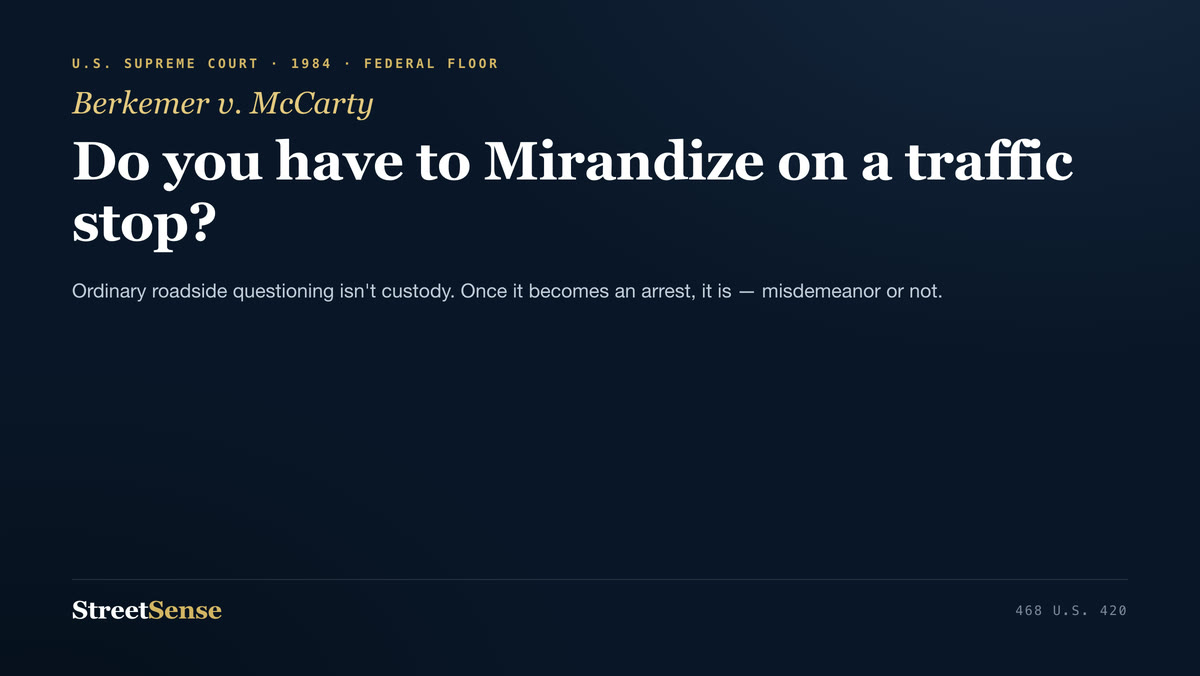
Roadside questioning during an ordinary traffic stop is not custodial interrogation for Miranda purposes: the detention is brief, public, and closer to a Terry stop than a station-house arrest. But once a driver is subjected to treatment that renders them in custody, Miranda applies in full — and it applies to misdemeanors exactly as it does to felonies.
Berkemer v. McCarty, 468 U.S. 420 (1984) — read the opinion on CourtListener.
What does Berkemer allow?
- Asking a moderate number of investigative questions at the roadside without warnings
- Requesting field sobriety tests during that ordinary stop
- Using the driver’s roadside answers without a prior warning, where the stop stayed an ordinary stop
What does it NOT allow?
- Skipping Miranda after an arrest because the charge is ‘only’ a misdemeanor or a DWI
- Treating a stop that has escalated into a de facto arrest — prolonged, restrained, moved — as still non-custodial
- Continuing custodial questioning after the driver is cuffed and in the back of the car without warnings
How it plays out on the street
The line is escalation. Ordinary stop, ordinary questions: no warnings needed. The moment you cuff, place in the car, or restrain to the degree associated with formal arrest and keep asking questions, you’re in Miranda territory — and the fact that it’s a DWI or a disorderly persons offense changes nothing. Note this is the federal floor; some states treat roadside detention as custodial earlier, and several require recorded custodial interrogation.
Frequently asked questions
Do I need Miranda at a DWI stop?
Not for ordinary roadside questioning and field sobriety tests. Once you arrest and want to interrogate, warnings are required.
Does Miranda apply to misdemeanors?
Yes. Berkemer rejected any misdemeanor exception — custodial interrogation requires warnings regardless of the offense's severity.
Related cases
- Miranda v. Arizona (1966): When Do You Actually Have to Read Rights?
- NJ DWI Laws: A Patrol Officer’s Complete Field Reference
- Birchfield v. North Dakota (2016): Breath Test vs. Blood Test on a DUI Arrest
Carry the rule, not the guesswork. Every case in StreetSense is broken down like this — bottom line, limits, and the exact citation — verified against the real opinion and available fully offline on shift. Start the free trial.
StreetSense is an educational reference for law enforcement, not legal advice. Federal cases set the floor — your state constitution, statutes, and department policy can impose stricter limits. Always follow your state’s rule and your agency’s policy.
Spot an error? Email nick@mnsindustriesllc.com with the post and your source. Corrections to the app go out over the air. How we verify.