

The driver’s acting hinky and you spot something under the seat. Can you check the car for weapons without an arrest? Michigan v. Long says yes — if you can articulate the danger.
What did Michigan v. Long decide?
The Terry protective-frisk principle extends to the passenger compartment of a vehicle. Officers may conduct a limited search of areas where a weapon could be placed or hidden if they have reasonable suspicion, based on specific articulable facts, that the suspect is dangerous and may gain immediate control of a weapon.
Michigan v. Long, 463 U.S. 1032 (1983) — read the opinion on CourtListener.
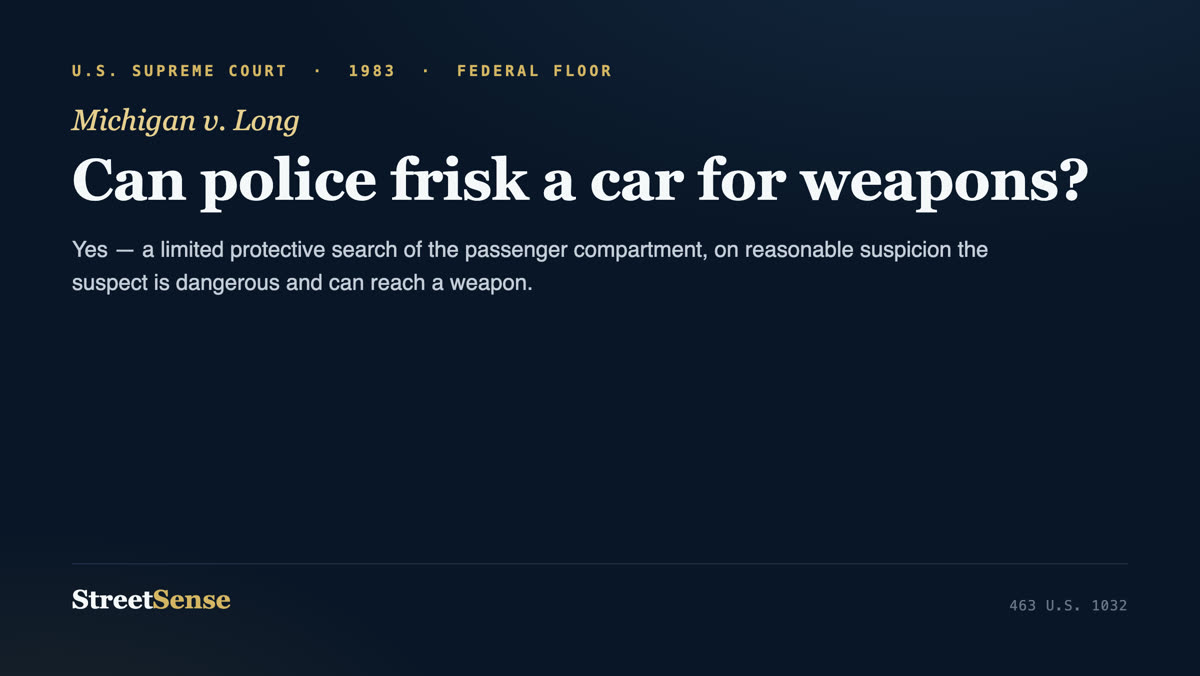
What does Michigan v. Long allow?
- A limited protective search of the passenger compartment for weapons on reasonable suspicion the suspect is dangerous and could access one
- Searching places a weapon could be hidden or placed
What does it NOT allow?
- A full evidentiary search of the vehicle under this doctrine — that needs probable cause or another exception (see Gant)
- A frisk with no articulable basis to believe the suspect is dangerous or armed
How it plays out on the street
This is a frisk of the car, not a search for evidence — reasonable suspicion of danger, limited to grabbable areas. If you’re really after evidence, you need probable cause and the automobile exception or a Gant analysis. Say why you feared a weapon. Federal floor; state law and policy can be stricter.
Frequently asked questions
Can I search a car for weapons without arresting anyone?
Yes — a limited protective search of the passenger compartment is allowed under Michigan v. Long when you have reasonable suspicion the person is dangerous and could reach a weapon.
How far does it go?
Only to areas where a weapon could be placed or hidden. It’s a protective frisk of the car, not a full evidence search.
Related cases
- Terry v. Ohio: Reasonable Suspicion on Every Traffic Stop
- Pennsylvania v. Mimms (1977): Ordering the Driver Out
- Arizona v. Gant (2009): Can Police Search Your Car After Arrest?
Carry the rule, not the guesswork. Every case in StreetSense is broken down like this — bottom line, limits, and the exact citation — verified against the real opinion and available fully offline on shift. Start the free trial.
StreetSense is an educational reference for law enforcement, not legal advice. Federal cases set the floor — your state constitution, statutes, and department policy can impose stricter limits. Always follow your state’s rule and your agency’s policy.