
Fingerprints, mugshot… DNA? Maryland v. King says a cheek swab at booking is just part of the process for a serious arrest.
What did Maryland v. King decide?
When officers make an arrest supported by probable cause for a serious offense and bring the suspect to the station, taking and analyzing a DNA cheek swab is a legitimate, reasonable booking procedure under the Fourth Amendment — comparable to fingerprinting and photographing.
Maryland v. King, 569 U.S. 435 (2013) — read the opinion on CourtListener.
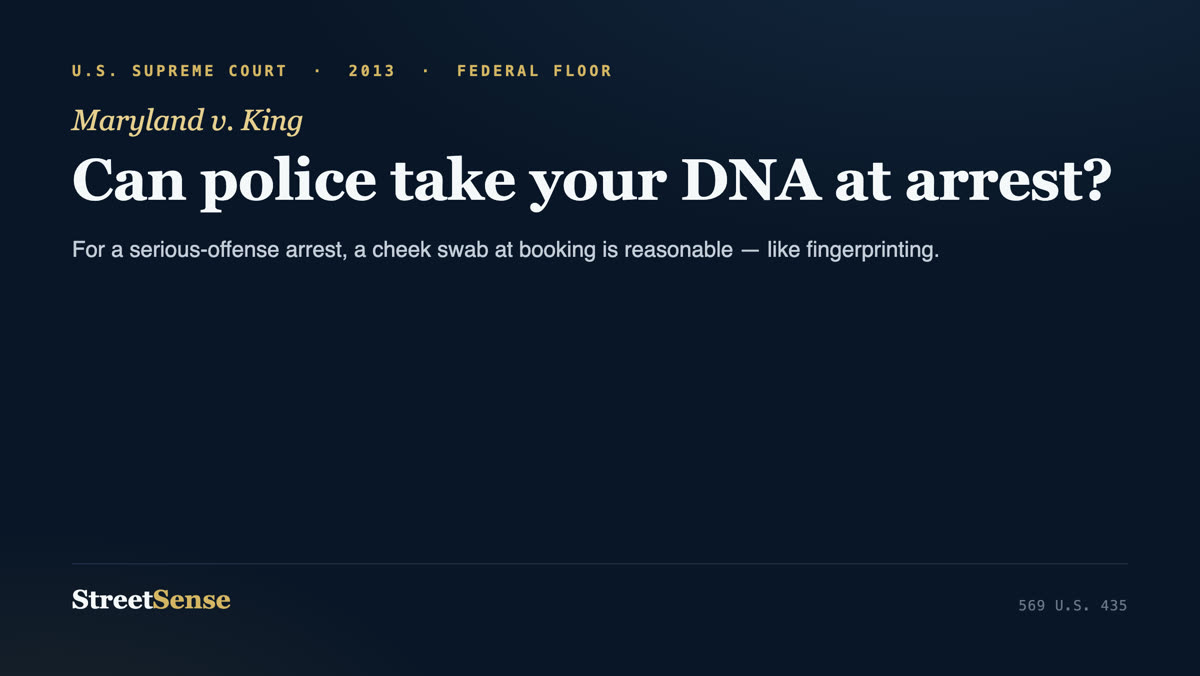
What does Maryland v. King allow?
- A buccal (cheek) DNA swab as part of booking for a serious-offense arrest supported by probable cause
- Treating DNA identification like fingerprinting and photographing at intake
What does it NOT allow?
- Extending the rationale beyond the booking and identification context the Court approved
- Ignoring your state’s DNA statute — many limit which offenses trigger collection and how samples are retained or expunged
How it plays out on the street
King treats DNA at booking like a modern fingerprint for serious arrests — but the details (which offenses, retention, expungement) are governed by your state’s DNA statute, which is often narrower. Follow your state law and your booking policy. Federal floor.
Frequently asked questions
Can police take DNA when they arrest someone?
For a serious-offense arrest supported by probable cause, Maryland v. King allows a cheek swab as a routine booking procedure, like fingerprinting.
Does it apply to every arrest?
No. King involved a serious offense, and state DNA-collection statutes control which arrests qualify, plus retention and expungement. Follow your state’s law.
Related cases
- Riley v. California (2014): Can Police Search Your Phone After Arrest?
- U.S. v. Robinson (1973): How Far a Search Goes After Arrest
- Birchfield v. North Dakota (2016): Breath Test vs. Blood Test on a DUI Arrest
Carry the rule, not the guesswork. Every case in StreetSense is broken down like this — bottom line, limits, and the exact citation — verified against the real opinion and available fully offline on shift. Start the free trial.
StreetSense is an educational reference for law enforcement, not legal advice. Federal cases set the floor — your state constitution, statutes, and department policy can impose stricter limits. Always follow your state’s rule and your agency’s policy.