

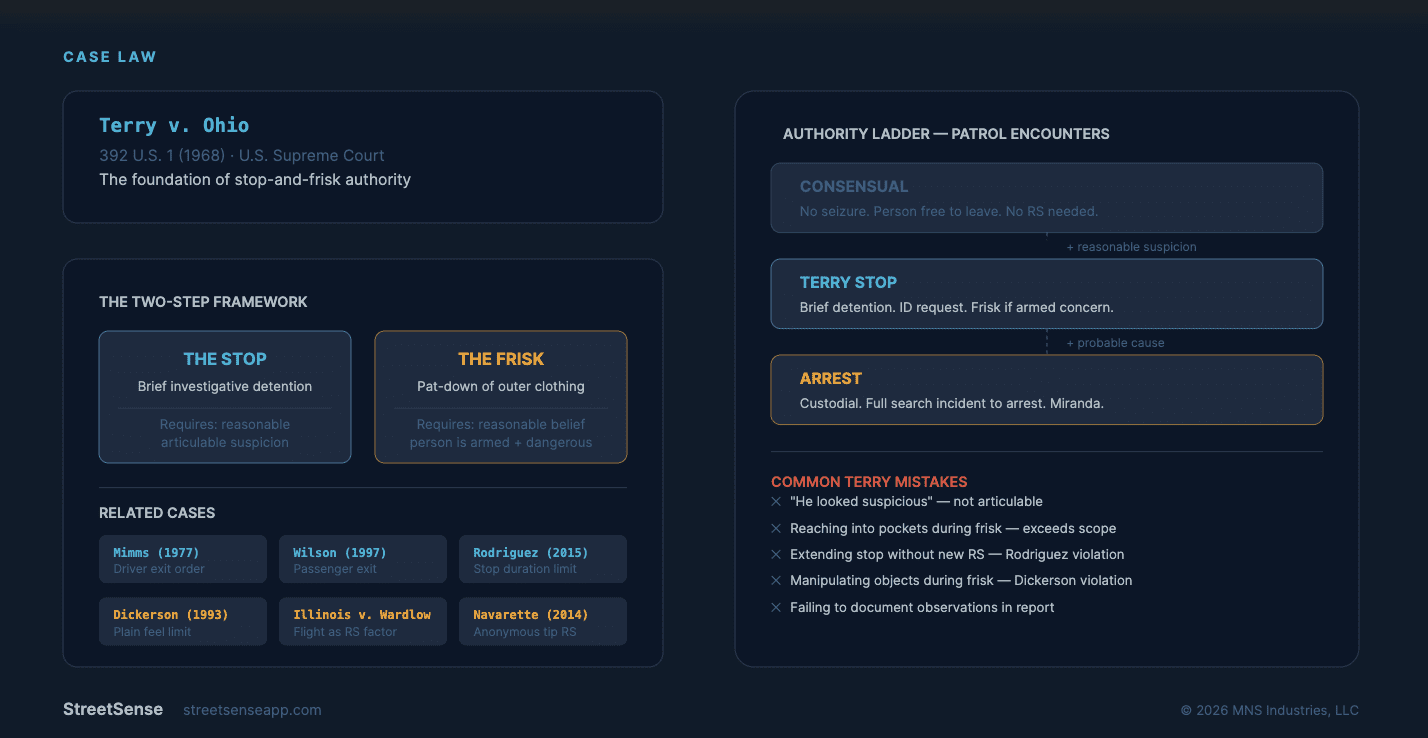
Every cop in America knows the name Terry v. Ohio. It’s the case that established your authority to conduct a brief investigative detention based on reasonable suspicion — the stop-and-frisk that defines the boundary between a consensual encounter and a lawful seizure. You learned it in the academy. You rely on it every shift.
But if you had to explain Terry to a defense attorney on cross-examination — the actual holding, not just “I had reasonable suspicion” — could you do it clearly? Most officers know what Terry lets them do. Fewer can articulate why, and where the limits are.
The Case: What Actually Happened
In 1968, Cleveland Detective Martin McFadden observed two men repeatedly walking past a store, peering into the window, and conferring with each other. A third man joined them briefly. McFadden, a 39-year veteran, suspected the men were casing the store for a robbery. He approached, identified himself as a police officer, and asked for their names. When the responses were mumbled, he grabbed one of the men (John Terry), turned him around, and patted down the outside of his clothing. He felt a pistol in the overcoat pocket and retrieved it.
The question before the Supreme Court: was McFadden’s pat-down a lawful search under the Fourth Amendment, even though he didn’t have probable cause for arrest?
The Court held that the Fourth Amendment permits a two-step process: first, a brief detention (the “stop”) based on reasonable suspicion; second, a limited pat-down of the outer clothing (the “frisk”) if the officer has reason to believe the person may be armed. Both steps require articulable facts — not just a hunch.
Reasonable Suspicion: The Standard
Terry established reasonable suspicion as the threshold for an investigative detention. It’s less than probable cause but more than a hunch. The Court defined it as “specific and articulable facts which, taken together with rational inferences from those facts, reasonably warrant the intrusion.”
The key word is “articulable.” You have to be able to explain, in specific terms, what you observed and why it led you to suspect criminal activity. “He looked suspicious” is not reasonable suspicion. “He was walking back and forth in front of the jewelry store, peering into the window each time, and then conferring with another individual who then walked the same pattern — consistent with casing behavior for a potential robbery” is reasonable suspicion.
Training and experience count. The Court specifically noted that McFadden’s 39 years of experience informed his interpretation of what he observed. An officer’s specialized knowledge — recognizing drug transaction patterns, stolen vehicle indicators, casing behavior — is a legitimate factor in forming reasonable suspicion. But it supplements specific observations; it doesn’t replace them.
The Frisk: Scope and Limits
The Terry frisk is not a search. It’s a limited pat-down of the outer clothing for weapons. The justification is officer safety — the frisk is permitted when the officer reasonably believes the person may be armed and dangerous.
What you can do: run your hands over the outside of the clothing to check for weapons. If you feel an object that could reasonably be a weapon (hard object in the waistband, bulge consistent with a firearm in a pocket), you can reach in and retrieve it.
What you cannot do: reach into pockets to search for evidence. Manipulate objects you feel during the pat-down to determine if they’re contraband (this is the “plain feel” limitation from Minnesota v. Dickerson). The frisk is about weapons, not evidence. If you feel something that is immediately identifiable as contraband by its shape and feel without any manipulation, that’s plain feel doctrine — but you can’t squeeze, slide, or manipulate to identify it.
Terry, Miranda, Rodriguez — all in plain English.
StreetSense includes 1,200+ case law entries with “what this means for patrol” guidance. Review them before your shift, not during testimony.
How Terry Applies to NJ Traffic Stops
On patrol in NJ, Terry comes into play constantly — usually without officers consciously thinking about it. Every traffic stop begins with at least reasonable suspicion of a traffic violation (or probable cause to believe one occurred). But where Terry’s frisk authority becomes critical is when the stop evolves beyond the initial citation.
Ordering the driver out: Pennsylvania v. Mimms (1977) established that officers can order a driver out of the vehicle during a lawful traffic stop as a matter of course — no additional suspicion needed. Maryland v. Wilson (1997) extended this to passengers. These are Terry’s progeny, and they apply in NJ.
Frisking during a traffic stop: If you order someone out and you have reasonable belief they may be armed — based on specific articulable facts like a visible bulge, furtive movements toward the waistband, prior knowledge of weapons history, or statements — you can conduct a Terry frisk. The key is the articulable belief. “I always frisk everyone I pull out” is not lawful under Terry. “I observed the driver reach toward his waistband twice during my approach, and when ordered out, he turned his right hip away from me” — that’s articulable.
Extending the stop: This is where Rodriguez v. United States (2015) intersects with Terry. You can’t extend a traffic stop beyond its original purpose without additional reasonable suspicion. If you write the ticket and the purpose of the stop is complete, holding the driver for a K-9 sniff or further investigation requires a new, independent basis of reasonable suspicion. Terry authorizes brief detentions — not open-ended fishing expeditions.
Common Mistakes Officers Make
Confusing a hunch with reasonable suspicion: “Something felt off” or “he seemed nervous” alone won’t hold up. Nervousness during a police encounter is normal and courts know it. You need specific behavioral facts beyond garden-variety anxiety.
Exceeding the scope of the frisk: A Terry frisk is outer clothing only, for weapons. If you’re reaching into pockets, unzipping jackets, or manipulating objects, you’ve exceeded Terry’s scope and you’re in search territory — which requires probable cause or consent.
Failing to articulate: The biggest failure isn’t doing the wrong thing — it’s doing the right thing and not documenting why. If you had legitimate reasonable suspicion and conducted a lawful frisk, but your report just says “I conducted a pat-down,” you’ve undermined your own work. Write down what you observed, what you suspected, and why you believed the person might be armed.
The Bottom Line
Terry v. Ohio is the foundation of modern patrol work. The stop-and-frisk framework it established defines your authority every time you detain someone based on suspicion short of probable cause. Knowing the holding is the minimum. Knowing the limits — and being able to articulate why your actions fell within those limits — is what the training is really about.
StreetSense includes Terry and hundreds of other cases that shape patrol authority, each written with a “what this means for you” section in plain English. It’s the kind of resource worth reviewing regularly, not just once in the academy.
1,200+ case law entries. Plain English. Offline.
Study the cases that define your authority. StreetSense covers Terry, Miranda, Rodriguez, Mimms, and hundreds more.
The information provided on this blog is for general informational and educational purposes only and does not constitute legal advice. Statutes, case law, and agency directives are subject to change, amendment, and judicial interpretation at any time. This blog is published by MNS Industries, LLC, the developer of the StreetSense app. Content is written from a law enforcement perspective and is intended to support — not replace — department training, official policy, legal counsel, or prosecutorial guidance. Officers should always consult their department’s standard operating procedures, their county prosecutor’s office, and applicable Attorney General directives before making enforcement decisions. For corrections or questions: nick@mnsindustriesllc.com© 2026 MNS Industries, LLC. All rights reserved.