

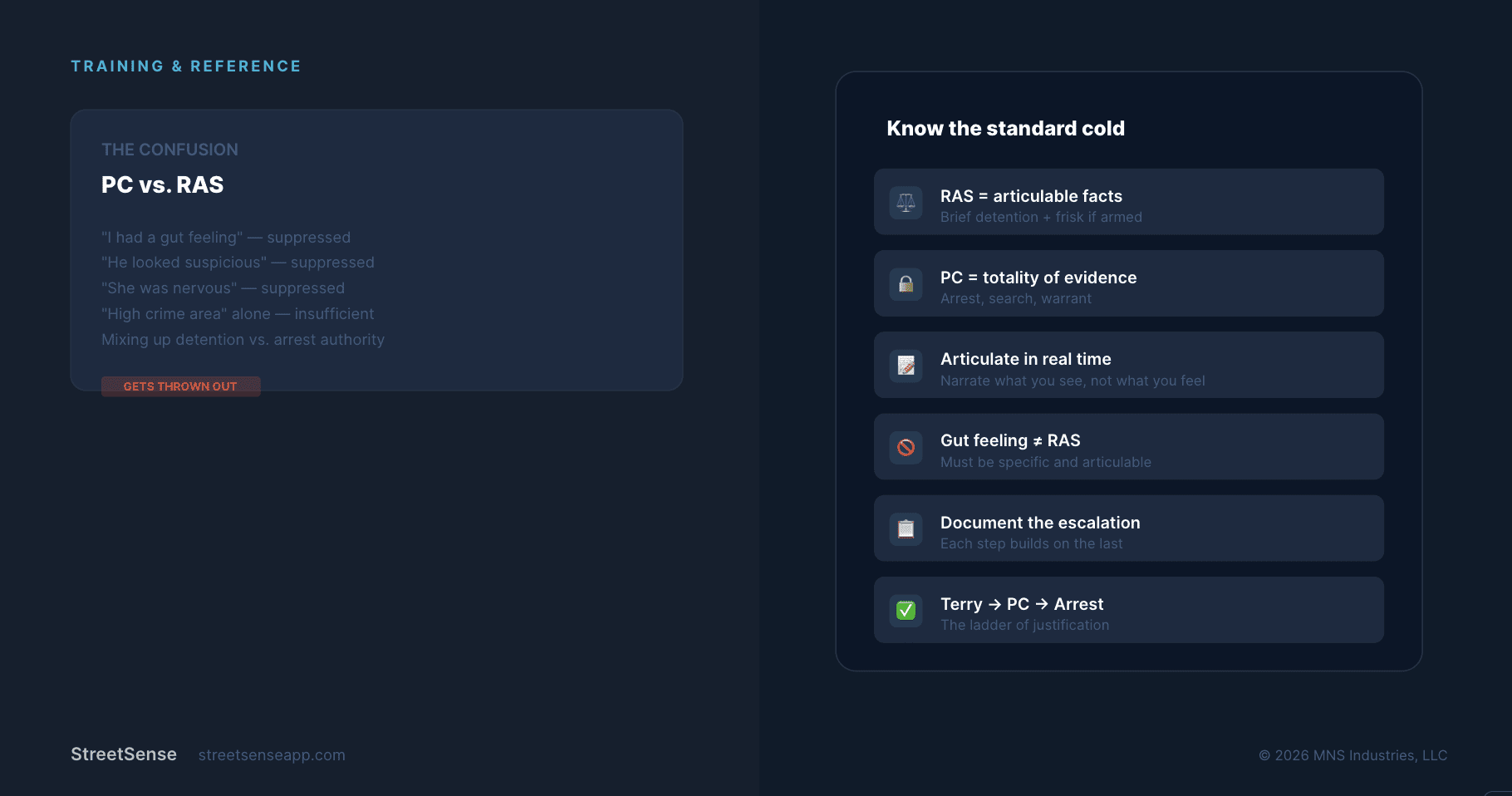
Ask ten officers to define the line between reasonable suspicion and probable cause, and you’ll get ten slightly different answers. That’s not because the standard is murky — it’s because the academy teaches it in the abstract, and the street demands you apply it in seconds.
Here’s how to think about both standards the way an experienced FTO would explain them — with real patrol scenarios, not law school hypotheticals.
Reasonable Suspicion — The “Something’s Off” Standard
Reasonable suspicion is what gets you out of the car. It’s specific, articulable facts that would lead a reasonable officer to believe criminal activity may be afoot. The key word is may. You don’t need to be certain. You don’t even need to be more likely right than wrong. You need enough to articulate why this person, in this place, at this time, doing this thing, triggered your training and experience.
What reasonable suspicion gets you: a brief investigative detention (Terry stop), a pat-down frisk for weapons if you reasonably believe the person is armed and dangerous, and a traffic stop based on observed violations.
What it does NOT get you: a full search of the person or vehicle, an arrest, or entry into a home.
Real Patrol Examples — RAS
A vehicle is circling a closed business at 3 AM with its lights off. A person matches a BOLO description and is walking away from the area of a just-reported robbery. A driver is weaving within their lane repeatedly while traveling well below the speed limit. A known narcotics location has a person conducting brief hand-to-hand exchanges on the corner.
Each of those gives you enough to stop. None of them gives you enough to search or arrest — not yet.
Probable Cause — The “More Likely Than Not” Standard
Probable cause is the upgrade. It’s a reasonable belief, based on the totality of circumstances, that a crime has been, is being, or is about to be committed — and that this specific person committed it. Or for a search, that evidence of a crime will be found in a particular place.
Think of it as the point where your facts tip from “something’s off” to “I can tell you what’s off and why.”
What probable cause gets you: an arrest, a search warrant application, a warrantless search under recognized exceptions (search incident to arrest, automobile exception, plain view, exigent circumstances), and charging decisions.
Real Patrol Examples — PC
You stop a vehicle for a moving violation. As you approach, you see an open container in the center console and the driver has slurred speech and glassy eyes. That’s probable cause for DWI investigation. The weaving alone was RAS for the stop — the totality of what you observed on approach built it to PC.
A person you stopped based on the robbery BOLO has a wallet in their pocket belonging to the victim, whose name was on the dispatch. RAS became PC the moment you could connect this person to this crime with specific evidence.
8,500+ statutes in your pocket.
Every statute, case, and directive — searchable and offline in the StreetSense app. Try free for 7 days.
The Ladder: How Encounters Escalate
Think of citizen encounters as a ladder. Each rung requires more justification:
Rung 1 — Consensual Encounter: No suspicion needed. You can walk up and talk to anyone. They can walk away at any time. The moment they can’t, it’s a seizure and you need RAS.
Rung 2 — Investigative Detention (Terry Stop): Requires reasonable articulable suspicion. Brief, limited in scope. You can ask questions, run them, and frisk for weapons if you reasonably believe they’re armed.
Rung 3 — Arrest: Requires probable cause. Full search incident to arrest. Miranda if you’re interrogating. Booking, charges, the whole process.
The mistake rookies make isn’t usually at the extremes — it’s in the middle. They treat a consensual encounter like a detention (ordering someone to stop when they had no RAS) or they treat a Terry stop like an arrest (searching pockets during a frisk when they felt no weapon).
Where Officers Get Tripped Up
“Gut feeling” is not RAS. Your instinct might be dead-on, but if you can’t articulate specific facts, you don’t have reasonable suspicion. Train yourself to narrate what you’re seeing in real time — even mentally. “The subject looked at my patrol car and immediately changed direction” is articulable. “He looked suspicious” is not.
RAS doesn’t freeze in time. Your suspicion can build, diminish, or disappear entirely during a stop. If everything checks out during a Terry stop — no warrants, valid ID, reasonable explanation — your RAS may evaporate. That means the stop is over. You can’t keep someone detained just because you still have a feeling.
Probable cause is not certainty. You don’t need to be 100% sure. You need a reasonable basis. Officers sometimes hesitate to make a good arrest because they’re waiting for the case to be “perfect.” If you have PC, act on it. The prosecutor can sort the rest.
How to Articulate Like a Pro
The best officers don’t just know the difference between RAS and PC — they document it in a way that holds up. Here’s the formula: state the facts you observed, connect them to your training and experience, and explain what those facts indicated.
Instead of: “The suspect was acting nervous.” Write: “The subject was visibly sweating despite 40-degree weather, avoided eye contact, and repeatedly glanced toward the vehicle’s center console — consistent in my training and experience with an individual who is concealing contraband or a weapon.”
Same observation. One gets thrown out. The other holds.
Bottom Line
Reasonable suspicion is the reason you stop. Probable cause is the reason you arrest or search. One is “I think something’s happening” backed by articulable facts. The other is “I know what happened” backed by evidence. Master the difference, articulate it clearly, and your stops will hold up every time.
The information provided on this blog is for general informational and educational purposes only and does not constitute legal advice. Statutes, case law, and agency directives are subject to change, amendment, and judicial interpretation at any time. This blog is published by MNS Industries, LLC, the developer of the StreetSense app. Content is written from a law enforcement perspective and is intended to support — not replace — department training, official policy, legal counsel, or prosecutorial guidance. Officers should always consult their department’s standard operating procedures, their county prosecutor’s office, and applicable Attorney General directives before making enforcement decisions. For corrections or questions: nick@mnsindustriesllc.com
© 2026 MNS Industries, LLC. All rights reserved.