

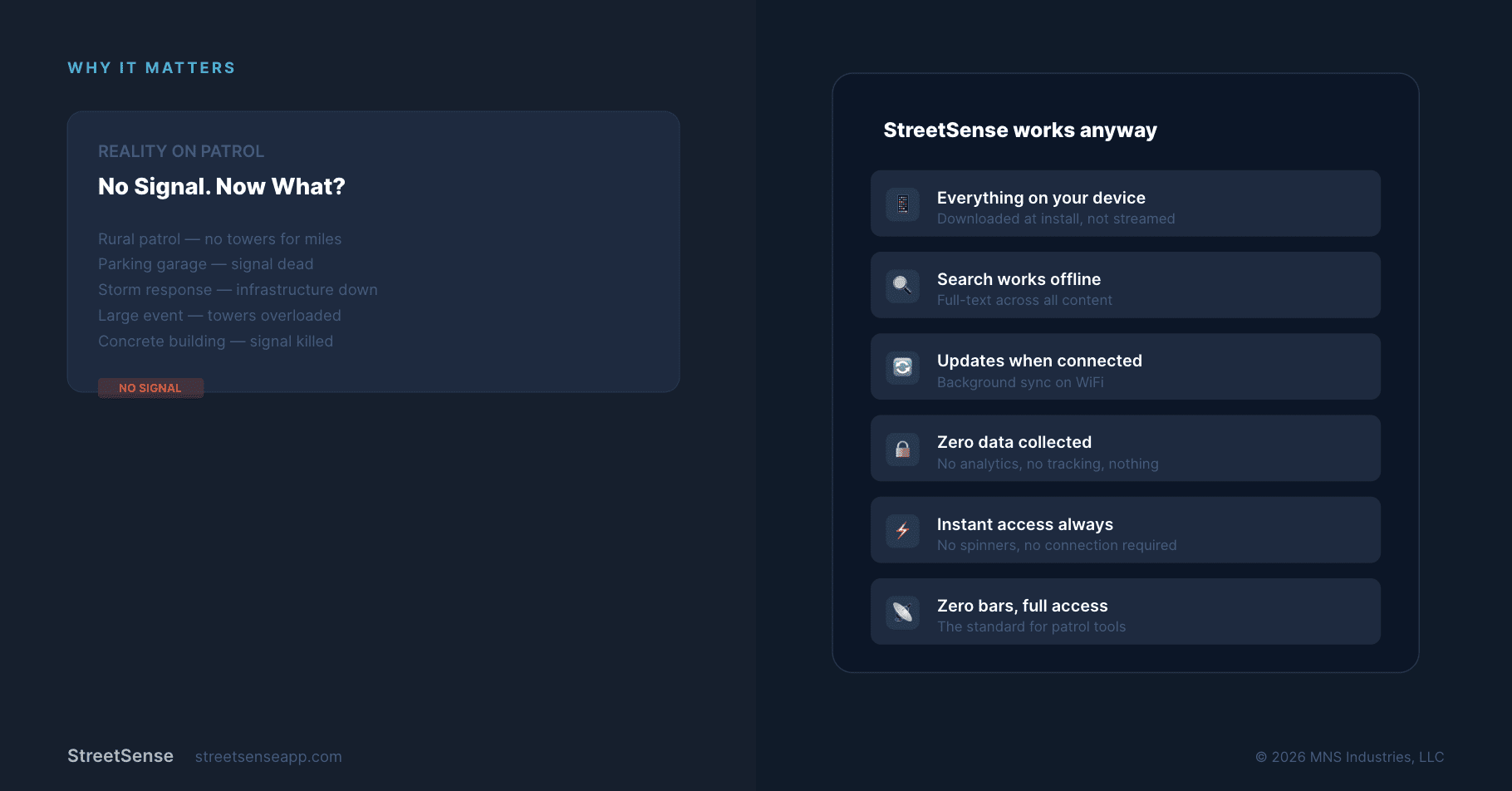
You’re on a traffic stop in a rural part of your jurisdiction. No cell signal. The driver hands you an out-of-state license and you need to confirm whether the statute you’re thinking of applies to non-residents. You pull out your phone, open your reference app, and — nothing. Spinning wheel. “No connection.”
That’s not a hypothetical. It happens every shift in departments across the country. Dead zones, underground parking garages, courthouse basements, buildings with concrete walls that kill signal, large-scale events where the cell towers are overloaded. If your reference tool needs the internet, it doesn’t work when you need it most.
The Problem with Cloud-Dependent Tools
Most legal reference apps and tools assume constant connectivity. They pull data from a server every time you open them. That works fine at a desk. It doesn’t work in a patrol car in the Pine Barrens, or in a parking deck during a suspicious vehicle call, or during a hurricane response when cell infrastructure is down.
Even apps that claim “offline support” often only cache what you’ve recently viewed. If you haven’t pulled up a particular statute before, it’s not available offline. That’s not offline access — that’s a browser cache pretending to be a feature.
8,500+ statutes in your pocket.
Every statute, case, and directive — searchable and offline in the StreetSense app. Try free for 7 days.
What 100% Offline Actually Means
A genuinely offline app stores everything on your device the moment you download it. Every statute. Every case law summary. Every AG directive. Every decision tree and quick reference card. Put your phone in airplane mode, walk into a Faraday cage, go into the deepest basement in your jurisdiction — it all still works.
Search works. Browsing works. Cross-references between statutes work. Everything. No loading screens, no “connection required,” no degraded experience.
Updates happen when you do have a connection — the app checks for new content and downloads it in the background. But once it’s on your device, it’s yours. No server dependency.
The Privacy Angle
There’s another reason offline matters that doesn’t get talked about enough: privacy. If an app needs a constant server connection, that means your searches are being transmitted. What statute did you look up? When? Where were you when you searched it? For how long?
That data trail could theoretically be subpoenaed, requested through FOIA, or compromised in a breach. An app that works 100% offline and collects zero data eliminates that entire concern. Your searches stay on your device. Period.
For officers, this isn’t paranoia — it’s operational security. What you research during an investigation shouldn’t be logged on someone else’s server.
When Offline Saves the Day
Large-scale events where thousands of people overwhelm the cell towers. Natural disasters that take down infrastructure. Rural patrols where coverage was never reliable. Underground locations — parking garages, subway stations, tunnel stops. Courthouses and government buildings with thick walls and poor reception. Night shifts in industrial zones with dead spots.
In each of those situations, the officer who has everything stored locally on their phone is the one who can still work. The one depending on a cloud app is stuck waiting for a signal that isn’t coming.
The Standard Should Be Higher
A patrol reference tool should work exactly as well on the side of the road at 3 AM with no signal as it does in the station house on WiFi. That’s not a premium feature — that’s the baseline. If you’re building a tool for law enforcement and it doesn’t work offline, you’re not building it for law enforcement. You’re building it for an office.
The information provided on this blog is for general informational and educational purposes only and does not constitute legal advice. Statutes, case law, and agency directives are subject to change, amendment, and judicial interpretation at any time. This blog is published by MNS Industries, LLC, the developer of the StreetSense app. Content is written from a law enforcement perspective and is intended to support — not replace — department training, official policy, legal counsel, or prosecutorial guidance. Officers should always consult their department’s standard operating procedures, their county prosecutor’s office, and applicable Attorney General directives before making enforcement decisions. For corrections or questions: nick@mnsindustriesllc.com
© 2026 MNS Industries, LLC. All rights reserved.