

Every officer in New Jersey has had this conversation on the side of the road: “How many points is this gonna be?” Drivers want to know. And honestly, a lot of officers aren’t 100% certain on the full breakdown beyond the violations they write most often.
This isn’t the “how to fight your ticket” post — there are a thousand of those written by defense attorneys. This is the officer-facing breakdown of how the NJ MVC point system actually works, so you can explain it accurately on scene and understand what your citations trigger downstream.
How the Point System Works
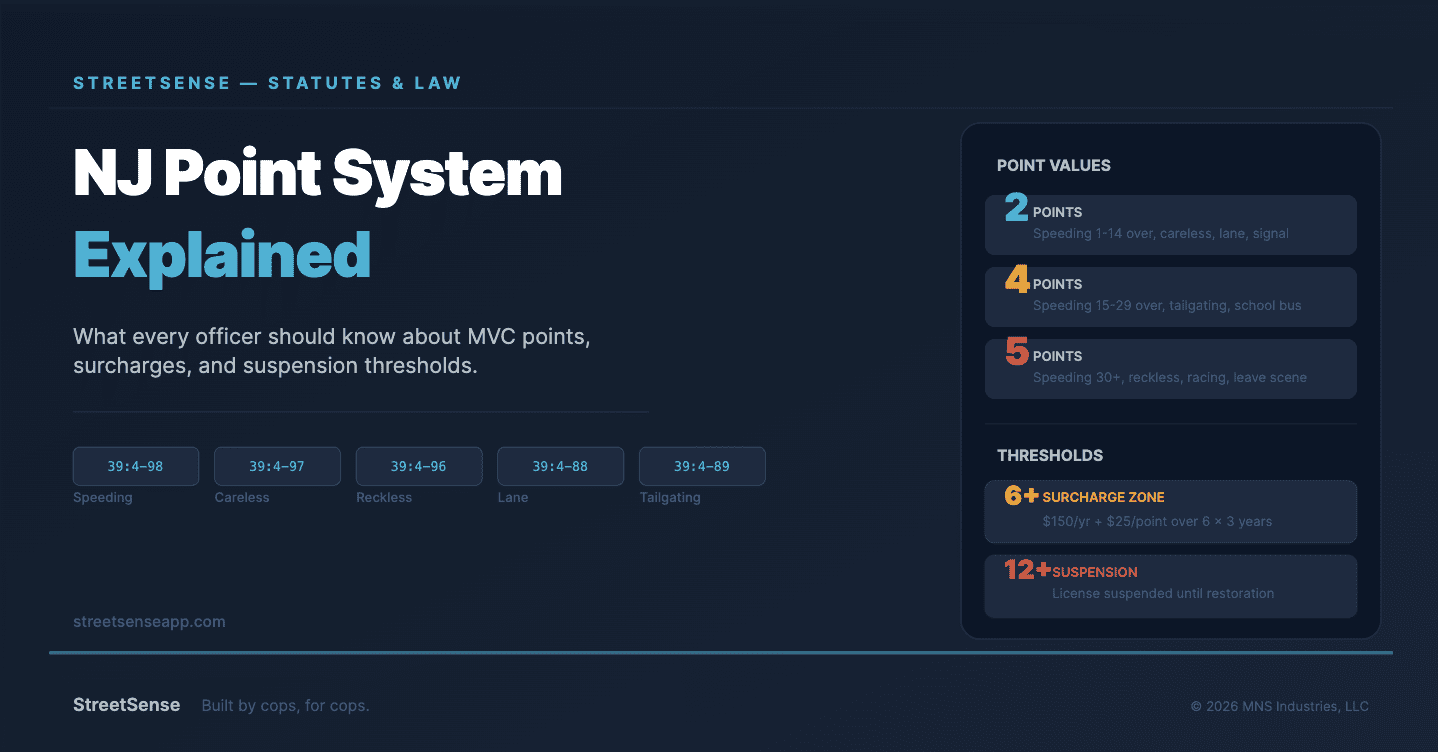
The New Jersey Motor Vehicle Commission assigns points to most moving violations. Points accumulate on the driver’s record and trigger escalating consequences — surcharges at 6 points, potential suspension at 12 points. Points stay on the record and are calculated on a rolling basis.
The surcharge system is what most drivers don’t understand — and what catches them off guard. It’s not a one-time fine. It’s an annual surcharge assessed by the MVC, separate from any court fines, and it continues for three years from the date it’s assessed. A driver sitting at 8 points is paying $200 per year for three years on top of whatever their tickets cost.
Point Values by Violation
Here’s the breakdown officers should know. These are the violations you write most often and the points that attach to each one.
2-Point Violations
The bread and butter of traffic enforcement. These are the violations you’ll write multiple times per shift.
Note the speeding breakdown here — 1-14 over is only 2 points. Most drivers assume any speeding ticket is devastating to their record. At 2 points, a single speeding ticket isn’t going to trigger surcharges on its own. But it stacks fast if they already have points from other violations.
3-Point Violations
4-Point Violations
This is where it starts to hurt. One 4-point violation plus one 2-point violation within three years and the driver is at 6 — surcharge territory.
5-Point Violations
The heavy hitters. A single 5-point violation puts a driver one minor ticket away from surcharges.
Reckless driving at 5 points is worth noting because careless driving — which officers sometimes default to when they mean reckless — is only 2 points. That’s a 3-point difference based on one word in the charge. If the behavior was truly reckless (willful disregard for safety), the 5-point charge is appropriate. If it was just negligent, careless is the right call. Know the distinction and charge accordingly.
Every NJ traffic statute with point values built in.
StreetSense shows the MVC points, penalty range, and companion charges for every violation. No more guessing on scene.
No-Point Violations
Not everything carries points. These are the violations that hit the wallet but don’t touch the driving record:
No insurance is the big one here. No points, but $300-$1,000 fine plus a one-year license suspension plus community service on a first offense. Drivers tend to focus on points and ignore the no-point violations that actually carry harsher consequences. When someone asks “how many points is this,” and you’re writing no insurance, the honest answer is “zero points — but here’s what’s actually going to happen.”
How Drivers Reduce Points
Officers get asked this constantly: “Is there anything I can do about the points?” There are two legitimate ways:
Defensive Driving Course: Completing an MVC-approved defensive driving program removes 2 points from the driver’s record. This can only be used once every five years. It’s a 6-hour course and it’s the most common approach.
Violation-Free Driving: For every full year a driver goes without a moving violation or suspension, 3 points are removed from their record. This is automatic — they don’t have to apply for it.
There’s no third option. You can’t “pay extra” to remove points, you can’t take the course twice in one year, and points don’t expire on a fixed timeline — they’re only removed through the two methods above. If someone on the side of the road tells you they heard you can take a course to make the ticket go away entirely, that’s not accurate. The course removes points from the record; it doesn’t dismiss the citation or eliminate the fine.
Surcharges: The Hidden Cost
This is what most drivers — and honestly some officers — don’t fully understand. The NJ Surcharge Violation System (NJSVS) is separate from court fines and MVC points. It’s administered by a third-party contractor, and the letters come separately from MVC correspondence.
At 6+ points within three years, the MVC assesses a $150 annual surcharge plus $25 for each point above 6. This is charged annually for three consecutive years. A driver at 9 points is paying $225/year for three years — $675 total in surcharges alone, on top of their original fines.
Certain violations also trigger automatic surcharges regardless of point total. DWI carries a $1,000 annual surcharge for three years. Driving without insurance triggers its own surcharge. These are separate from the point-based surcharge and can stack.
Failure to pay surcharges results in license suspension. This is how many drivers end up in a cycle: they get tickets, can’t afford the surcharges, get suspended for non-payment, then get caught driving while suspended and it compounds from there.
What This Means for You on Patrol
Understanding the point system doesn’t change what you charge — you charge what the violation is. But it helps in two ways:
First, it helps you explain things accurately when drivers ask. “How many points is this?” is a fair question, and giving a confident, correct answer builds professionalism and public trust.
Second, it helps you understand the downstream consequences of what you’re writing. A driver sitting at 10 points who picks up a 4-point violation is going to get suspended. That doesn’t mean you shouldn’t write the ticket — but understanding the system gives you context for the encounters you’re having.
Every NJ traffic statute in StreetSense includes the point value, fine range, and companion charges so you can review it during downtime or before a shift. It’s the kind of thing that’s worth studying once and having at your fingertips from then on.
833 NJ statutes. Points, penalties, and FTO notes on every one.
Study before your shift. Reference during downtime. StreetSense is the training tool that fits in your pocket.
The information provided on this blog is for general informational and educational purposes only and does not constitute legal advice. Statutes, case law, and agency directives are subject to change, amendment, and judicial interpretation at any time. This blog is published by MNS Industries, LLC, the developer of the StreetSense app. Content is written from a law enforcement perspective and is intended to support — not replace — department training, official policy, legal counsel, or prosecutorial guidance. Officers should always consult their department’s standard operating procedures, their county prosecutor’s office, and applicable Attorney General directives before making enforcement decisions. For corrections or questions: nick@mnsindustriesllc.com© 2026 MNS Industries, LLC. All rights reserved.