
DWI enforcement is one of the most complex areas of NJ traffic law, and it’s one where the details matter more than almost anything else you do on patrol. The statutes, the implied consent rules, the BAC thresholds, the CDL complications, the refusal penalties — all of it has to be right, and all of it has to be documented properly.
This is the comprehensive DWI reference written from the officer’s side. Not for the driver trying to beat a charge — for the officer who needs to know the framework inside and out during training, review, and pre-shift prep.
The Core Statute: N.J.S.A. 39:4-50
Everything starts here. 39:4-50 is the DWI statute in New Jersey, and it covers operation under the influence of intoxicating liquor, narcotic, hallucinogenic, or habit-producing drugs.
Important distinction: NJ DWI is a traffic offense, not a criminal charge. It’s handled in municipal court, not superior court. But don’t let the classification fool anyone — the penalties are severe and include mandatory jail time on subsequent offenses, substantial fines, ignition interlock requirements, and license suspension.
BAC Thresholds
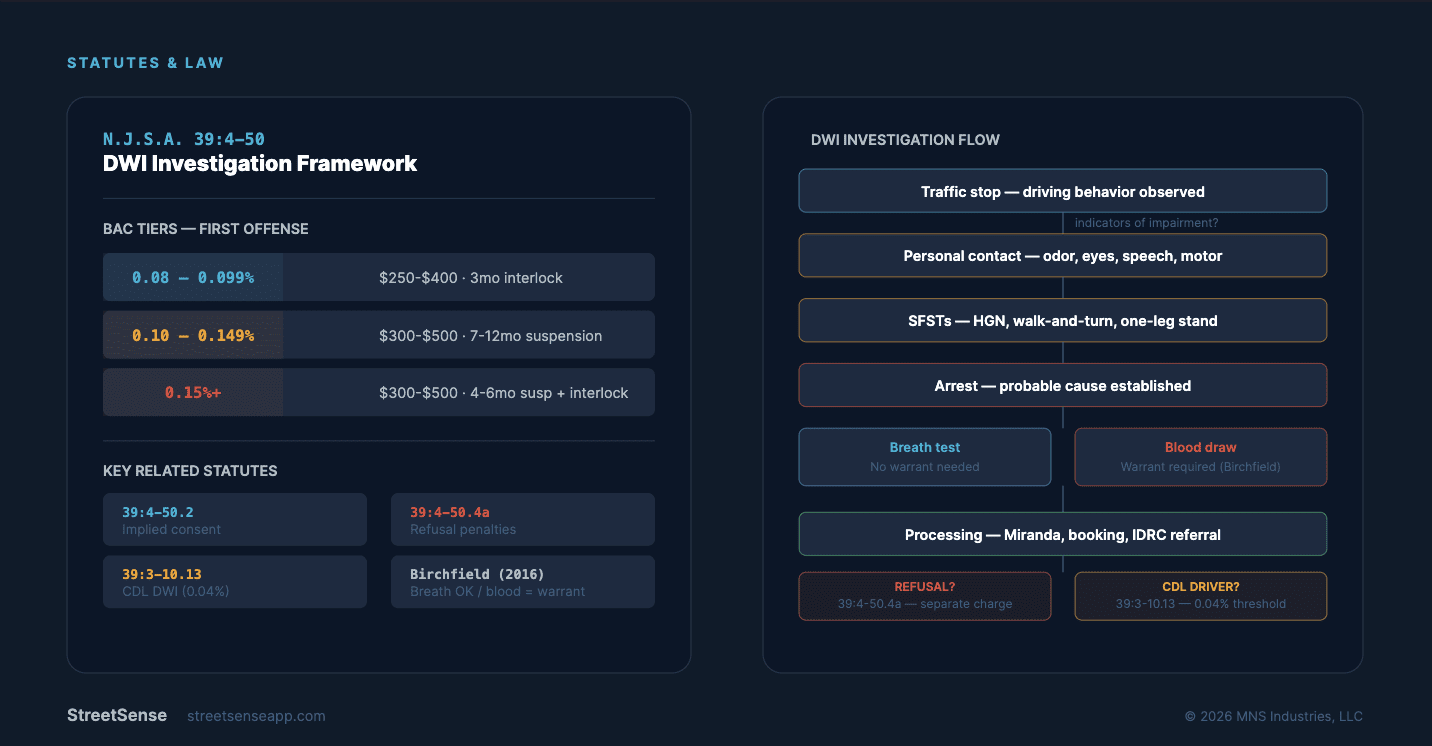
NJ uses a tiered penalty system based on BAC level for alcohol-related DWI. The thresholds determine fine amounts, license suspension periods, and ignition interlock requirements.
The 0.08% threshold is the per se limit — if the driver blows 0.08% or higher, that BAC reading alone is sufficient to establish the violation. You don’t need to prove impairment through observations if you have the BAC. But you should still document your observations anyway, because BAC results can be challenged on procedural grounds and your field observations become the backup.
CDL Holders
Commercial driver’s license holders are held to a stricter standard. The BAC threshold for CDL holders operating a commercial vehicle is 0.04% — half the standard limit.
A CDL holder caught at 0.05% in their personal vehicle gets the standard DWI under 39:4-50. But if they’re in the commercial vehicle, the 0.04% threshold applies. And the CDL disqualification is separate from — and in addition to — the regular license suspension.
Implied Consent and Refusal
New Jersey’s implied consent law is codified under 39:4-50.2. By operating a motor vehicle on NJ roads, a driver has implicitly consented to providing breath samples when requested by an officer with probable cause to believe they’re under the influence.
This is critical: refusal to submit to a breath test is a separate offense under 39:4-50.4a, and the penalties mirror (and in some cases exceed) a DWI conviction. A first-offense refusal carries the same penalties as a first-offense DWI in the highest BAC tier. The legislature designed it this way intentionally — refusing the test is not supposed to be the “better” option for the driver.
Birchfield and Blood Draws
Under Birchfield v. North Dakota (2016), the U.S. Supreme Court held that breath tests can be required as a search incident to arrest without a warrant, but blood draws require either consent or a warrant. NJ follows this framework — you can require a breath test post-arrest, but if you need a blood draw (drug-impaired driver, unconscious driver, medical facility), you need a warrant unless exigent circumstances apply or the driver consents.
DWI statutes, case law, and decision trees — all offline.
StreetSense includes the full DWI framework with officer notes, Birchfield guidance, and step-by-step investigation trees. Study before your next shift.
Penalties by Offense Number
NJ DWI penalties escalate significantly with each subsequent offense. Here’s the framework officers should know:
First Offense (BAC 0.08%-0.099%): $250-$400 fine, up to 30 days in jail, 3 months ignition interlock during which driving is permitted, IDRC (Intoxicated Driver Resource Center) for 12-48 hours, $230 IDRC fee, $100 drunk driving fund, $100 AERF, $75 SNF.
First Offense (BAC 0.10%-0.149%): $300-$500 fine, up to 30 days in jail, 7-12 months license suspension plus ignition interlock during suspension and 6-12 months after, same ancillary fees.
First Offense (BAC 0.15%+): $300-$500 fine, up to 30 days in jail, 4-6 months license suspension plus ignition interlock during and 9-15 months after restoration.
Second Offense: $500-$1,000 fine, 2-90 days in jail (mandatory minimum 2 days), 1-2 year license suspension, ignition interlock during suspension and 2-4 years after, 30 days community service.
Third+ Offense: $1,000 fine, 180 days in jail (mandatory minimum 180 days, up to 90 may be served in inpatient rehab), 8-year license suspension, ignition interlock during and after.
Drug-Impaired Driving
39:4-50 covers drug impairment as well as alcohol. The challenge with drug DWI is that there’s no per se BAC equivalent — you can’t blow into a machine and get a number. Drug-impaired driving cases rely on officer observations, standardized field sobriety tests, and Drug Recognition Expert (DRE) evaluations.
If you suspect drug impairment (bloodshot eyes, constricted or dilated pupils, unusual speech patterns, lack of convergence, performance on SFSTs inconsistent with BAC), document everything meticulously. A DRE evaluation can be requested but requires a certified DRE officer. Your observations and SFST results are the foundation of the case either way.
Documentation Checklist
This is what separates a solid DWI investigation from one that falls apart during review. Whether you’re studying for a promotional exam or reviewing your process before a shift, here’s what needs to be in the report:
Initial observations: driving behavior that prompted the stop, specific lane violations, speed, time of day, location. Personal contact observations: odor of alcohol, bloodshot/watery eyes, slurred speech, fumbling with documents, admissions. SFSTs: which tests administered, specific clues observed on each test, conditions (lighting, surface, weather, footwear). Breath test: 20-minute observation period documented, instrument serial number, two readings within tolerance, operator certification. Arrest and processing: time of arrest, Miranda if custodial interrogation follows, transport to station, booking.
The complete NJ DWI framework in your pocket.
39:4-50, implied consent, refusal, Birchfield, BAC tiers, penalties by offense — all with officer notes and companion charges.
The information provided on this blog is for general informational and educational purposes only and does not constitute legal advice. Statutes, case law, and agency directives are subject to change, amendment, and judicial interpretation at any time. This blog is published by MNS Industries, LLC, the developer of the StreetSense app. Content is written from a law enforcement perspective and is intended to support — not replace — department training, official policy, legal counsel, or prosecutorial guidance. Officers should always consult their department’s standard operating procedures, their county prosecutor’s office, and applicable Attorney General directives before making enforcement decisions. For corrections or questions: nick@mnsindustriesllc.com© 2026 MNS Industries, LLC. All rights reserved.