

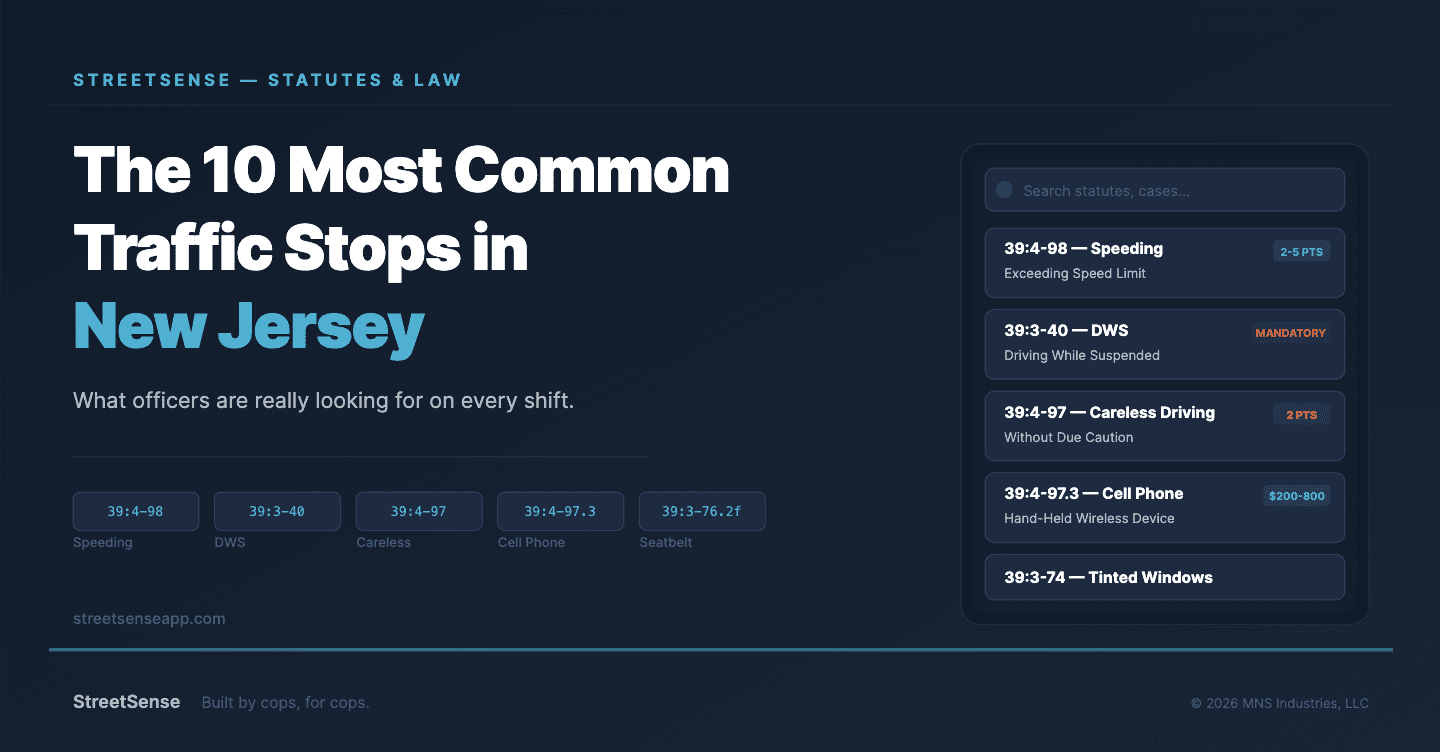
If you’ve worked patrol in New Jersey for more than a week, you already know the hits. The same violations show up on every shift, every township, every highway. But knowing the statute number is only half of it — knowing how it plays out on the street, what to look for, and what stacks with it is what separates a sharp officer from one who’s still second-guessing at the MDT.
Here are the 10 traffic violations NJ patrol officers encounter most often, with the statute cites, MVC point values, and field notes that actually matter.
1. Speeding — N.J.S.A. 39:4-98
The single most common traffic violation in New Jersey, and the one most officers could write in their sleep. But it’s worth knowing the tiers, because the points and fines scale significantly.
The field reality: most officers focus on radar/lidar calibration and visual estimate documentation. The difference between “I paced him at 72 in a 55” and “my radar indicated 72 in a posted 55 zone” matters when you’re writing reports. Document the method, the location, the conditions. If you’re writing 30+ over, consider whether reckless driving (39:4-96) is actually the better charge — that willful disregard element can be easier to articulate than you think when someone’s doing 85 in a 50.
2. Driving While Suspended — N.J.S.A. 39:3-40
This is the statute that trips up more rookies than any other in NJ. Not because it’s complicated — because the subsections matter enormously and choosing the wrong one changes the entire penalty structure.
The critical distinction: if the underlying suspension was DWI-related, you’re in a different subsection with significantly harsher penalties including mandatory jail even on a first offense. Always run the license and read why it’s suspended before you finalize the charge. A DWI-suspension DWS is not the same animal as a surcharge-suspension DWS, and writing the wrong one creates headaches later.
3. Careless Driving — N.J.S.A. 39:4-97
The catch-all. Officers reach for careless driving when someone’s doing something dangerous that doesn’t quite fit a more specific statute. And most of the time, that’s fine — it’s 2 points and a moderate fine. But know when careless isn’t enough.
The key language is “without due caution and circumspection, in a manner so as to endanger, or be likely to endanger, a person or property.” Compare that to reckless (39:4-96), which requires “willfully or wantonly” — meaning the driver knew the risk and didn’t care. If you’ve got a driver who’s weaving through traffic at 90 mph, that’s not careless. That’s reckless. The distinction matters for how the charge is handled.
4. Cell Phone / Hands-Free Violation — N.J.S.A. 39:4-97.3
This one has gotten significantly more aggressive in NJ. The fine escalation is steep and most drivers don’t realize how bad it gets by the third offense.
Field note: “hands-free” means hands-free. Holding the phone on speaker doesn’t count — it has to be a Bluetooth, dash mount, or similar setup where the driver isn’t holding the device. AirPods and earbuds in one ear are fine. The question officers get most: “What about a smartwatch?” The statute targets wireless telephones specifically, but if someone’s clearly distracted by any device, careless driving (39:4-97) is always available as a companion.
5. Seatbelt — N.J.S.A. 39:3-76.2f
NJ is a primary enforcement state, meaning you can stop someone solely for not wearing a seatbelt. No need for another violation to initiate the stop. This is worth knowing because it comes up in training scenarios — yes, the seatbelt alone is sufficient.
Child restraint violations under 39:3-76.2a carry a separate $75 fine for children under 8 or under 80 pounds not in an appropriate car seat. Rear seat passengers 18+ have been required to wear seatbelts since 2010. The fine is small, but primary enforcement means the stop itself is lawful based solely on the seatbelt observation.
6. Registration Violations — N.J.S.A. 39:3-4
Expired registration, no registration, unregistered vehicle — this is one of the most straightforward stops on patrol, but the details still trip people up.
The field notes that matter: out-of-state residents have 60 days to register in NJ after establishing residency. Temp tags have expiration dates printed on them — actually read it, don’t assume. Companion charge to always check: insurance (39:6B-2). Expired registration and no insurance often travel together.
7. Failure to Maintain Lane — N.J.S.A. 39:4-88
Failure to maintain lane is one of the most common initial observations that leads to further investigation. If someone’s drifting, weaving, or crossing the fog line, this is your articulable basis.
Documentation matters here more than most stops. Note the specific behavior: “crossed the center line twice within a quarter mile,” “drifted onto the right shoulder and corrected sharply,” “failed to maintain lane through a curve at well below the posted speed.” Be specific. Vague descriptions don’t hold up to scrutiny during review.
8,500+ statutes in your pocket.
Every statute, case, and directive — searchable and offline in the StreetSense app. Try free for 7 days.
8. No Insurance — N.J.S.A. 39:6B-2
NJ takes uninsured motorists seriously. The penalties are steep and there’s a mandatory license suspension component that catches drivers off guard.
Always give the driver a chance to produce proof. Insurance cards can be digital in NJ — an insurance app on their phone showing active coverage is acceptable. If they can’t produce proof on scene, the charge can still be addressed if they show proof of coverage that was active at the time of the stop. This is a charge worth stacking as a companion whenever you run a vehicle and insurance comes back negative.
9. Improper Turn / Failure to Signal — N.J.S.A. 39:4-126
One of those violations that’s everywhere but rarely the primary reason for a stop. More often it’s the companion charge or the initial observation that leads to something else.
The statute requires a signal for “not less than 100 feet” before turning in areas where the speed limit is 50 mph or less, and 300 feet where it’s above 50 mph. That’s a specific, measurable standard — and it’s worth noting in your documentation when you can estimate the distance. Companion charges: improper turn (39:4-123), failure to yield (39:4-72).
10. Tinted Windows — N.J.S.A. 39:3-74
One of the most-stopped violations in NJ and one of the most-contested. Know this statute cold.
NJ law prohibits aftermarket tint on the front windshield and front side windows (driver and passenger). Rear windows and rear windshield can be tinted to any degree. Medical exemptions exist — the driver should have documentation from their physician and a waiver from MVC. If they claim a medical exemption but have no paperwork, you can still write it and they can present the documentation later. A tint meter gives you objective, measurable evidence — if your department has one, use it and note the reading.
The Bottom Line
These 10 stops make up the bulk of what NJ patrol officers encounter on any given shift. The statutes themselves aren’t complicated — what separates experienced officers from rookies is knowing the nuances: when careless should actually be reckless, why the DWS subsection matters, what companion charges to check, and how to document properly.
Every one of these statutes — along with 800+ more — is in the StreetSense app with officer notes, point values, penalty breakdowns, and companion charges. It’s the kind of reference tool that makes studying before a shift or reviewing after one a lot faster.
**Keep in mind that this is OUR top 10 most common traffic stops in NJ. There is no public data that pinpoints this information, to our knowledge. If you disagree on this top 10, we totally get it! This is a great starting point**
All 833 NJ statutes. Officer notes on every one.
StreetSense puts every NJ traffic and criminal statute in your pocket with FTO-level field notes, companion charges, and search aliases. Study up before your shift or use as a quick reference during routine stops.
The information provided on this blog is for general informational and educational purposes only and does not constitute legal advice. Statutes, case law, and agency directives are subject to change, amendment, and judicial interpretation at any time. This blog is published by MNS Industries, LLC, the developer of the StreetSense app. Content is written from a law enforcement perspective and is intended to support — not replace — department training, official policy, legal counsel, or prosecutorial guidance. Officers should always consult their department’s standard operating procedures, their county prosecutor’s office, and applicable Attorney General directives before making enforcement decisions. For corrections or questions: nick@mnsindustriesllc.com© 2026 MNS Industries, LLC. All rights reserved.