

If you’re patrolling in Maryland and you smell marijuana during a traffic stop, your next move just got a lot more complicated. The Maryland Supreme Court’s decision in State v. Pacheco fundamentally changed how officers in the state can use marijuana odor during vehicle encounters.
Here’s what happened, what it means, and what you should be doing differently on every stop.
What the Court Said
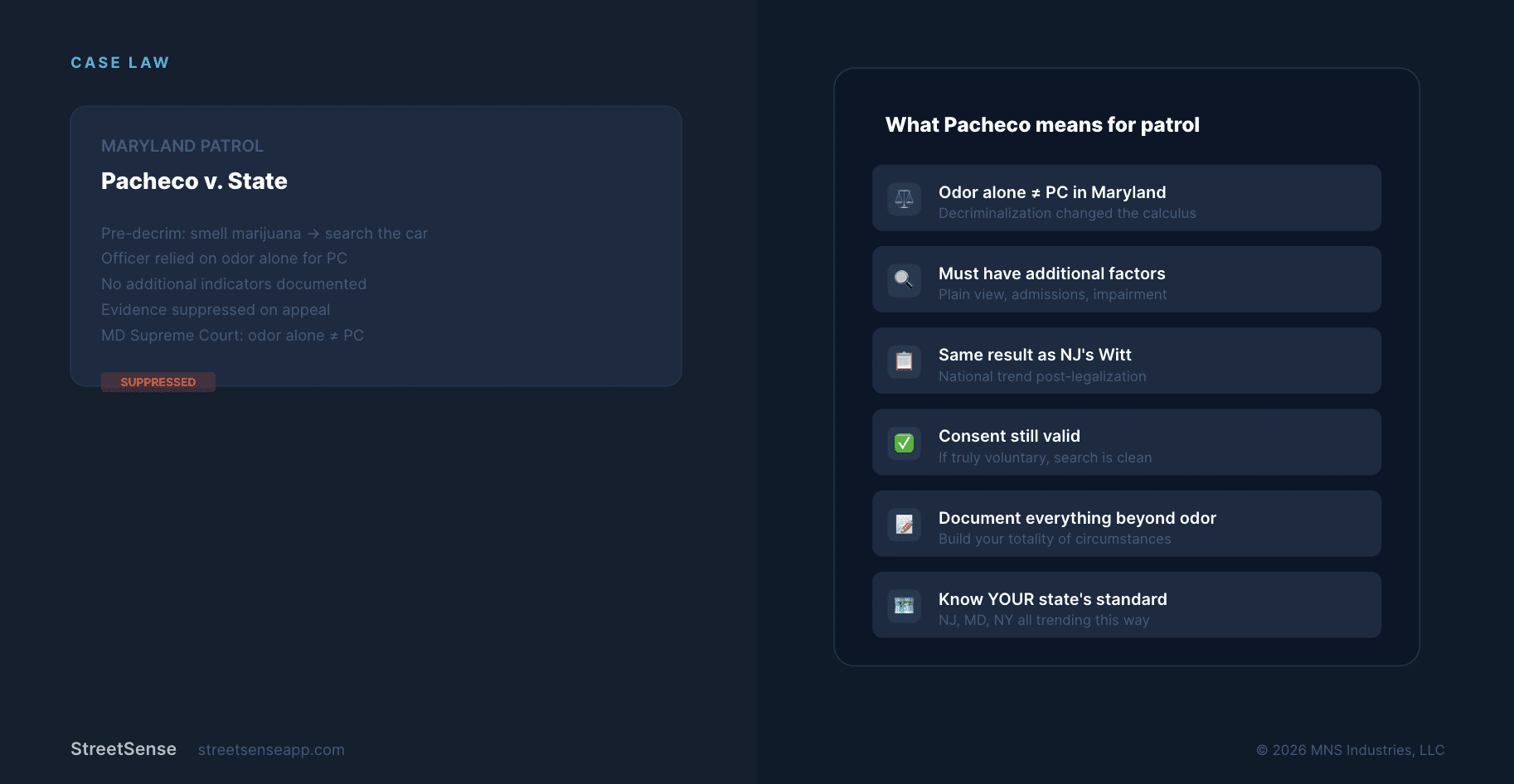
In Pacheco, the Maryland Supreme Court held that the odor of marijuana alone does not establish probable cause to search a vehicle. The reasoning is straightforward: Maryland decriminalized possession of less than 10 grams of marijuana. Since possessing a small amount is a civil citation — not a criminal offense — smelling it doesn’t necessarily mean a crime is being committed.
This doesn’t mean marijuana odor is irrelevant. It means it can’t be the sole basis for a search. It can still be one factor among many in building probable cause through the totality of the circumstances.
Why This Matters for Multi-State Officers
If you work near the Maryland border — or if you’re a Maryland officer who trained under the old standard — this is a significant shift. Before Pacheco, the odor of marijuana was essentially an automatic search trigger in most jurisdictions. Now, in Maryland, it’s a data point, not a green light.
This follows a trend. New Jersey reached a similar result through State v. Witt. New York’s cannabis legalization has similar implications. Pennsylvania is still operating under different rules. If you patrol anywhere near state lines, you need to know which standard applies in each jurisdiction.
What Still Gives You PC in Maryland
Marijuana odor plus additional indicators can still build probable cause. The key is “plus.” Odor combined with visible marijuana in plain view, odor combined with the driver admitting to having a large quantity, odor combined with indicators of distribution (baggies, scales, large amounts of cash), or odor combined with the driver being visibly impaired — those combinations can still get you to PC.
The officer’s training and experience still matters. You can articulate that in your experience, certain odor characteristics suggest larger quantities. But the odor alone, without more, falls short after Pacheco.
8,500+ statutes in your pocket.
Every statute, case, and directive — searchable and offline in the StreetSense app. Try free for 7 days.
Practical Adjustments for Patrol
Document everything beyond the odor. If you smell marijuana on a Maryland stop, note it — but keep investigating. What else are you seeing? Bloodshot eyes? Slow speech? Fumbling with documents? Open containers? Those details are what build your PC now.
Don’t lead with the search. Ask questions. “Have you been smoking?” If they admit to it, ask about quantity. Their answers become part of your totality. Consent is still valid — if a driver voluntarily consents to a search, Pacheco doesn’t change that calculus.
Know your state. Pacheco is Maryland law. If you’re in Pennsylvania on the same shift, different rules may apply. If you’re in New Jersey, Witt already took you here. Knowing which state’s case law controls your stop at any given moment is not optional — it’s the difference between a good search and a suppressed one.
The Bigger Picture
Pacheco is part of a nationwide recalibration. As more states decriminalize or legalize marijuana, courts are re-examining whether the odor of a substance that may be lawfully possessed can justify the intrusion of a vehicle search. The trend is clear: odor alone is losing its power as a standalone basis for PC.
Officers who adapt — who build thorough, well-articulated probable cause from multiple factors — won’t miss a beat. The ones who relied on “I smelled marijuana” as a one-line justification need to evolve.
The information provided on this blog is for general informational and educational purposes only and does not constitute legal advice. Statutes, case law, and agency directives are subject to change, amendment, and judicial interpretation at any time. This blog is published by MNS Industries, LLC, the developer of the StreetSense app. Content is written from a law enforcement perspective and is intended to support — not replace — department training, official policy, legal counsel, or prosecutorial guidance. Officers should always consult their department’s standard operating procedures, their county prosecutor’s office, and applicable Attorney General directives before making enforcement decisions. For corrections or questions: nick@mnsindustriesllc.com
© 2026 MNS Industries, LLC. All rights reserved.