

New Jersey has some of the most complex firearms laws in the country. For patrol officers, that complexity shows up on traffic stops, domestic violence calls, and warrant service — and getting it wrong can mean either letting a dangerous person walk or violating someone’s rights. Here’s what you actually need to know on the street.
The Big Three: 2C:39-5, 2C:39-4, and 2C:58-3
Almost every weapons encounter on patrol comes back to one of these three statutes.
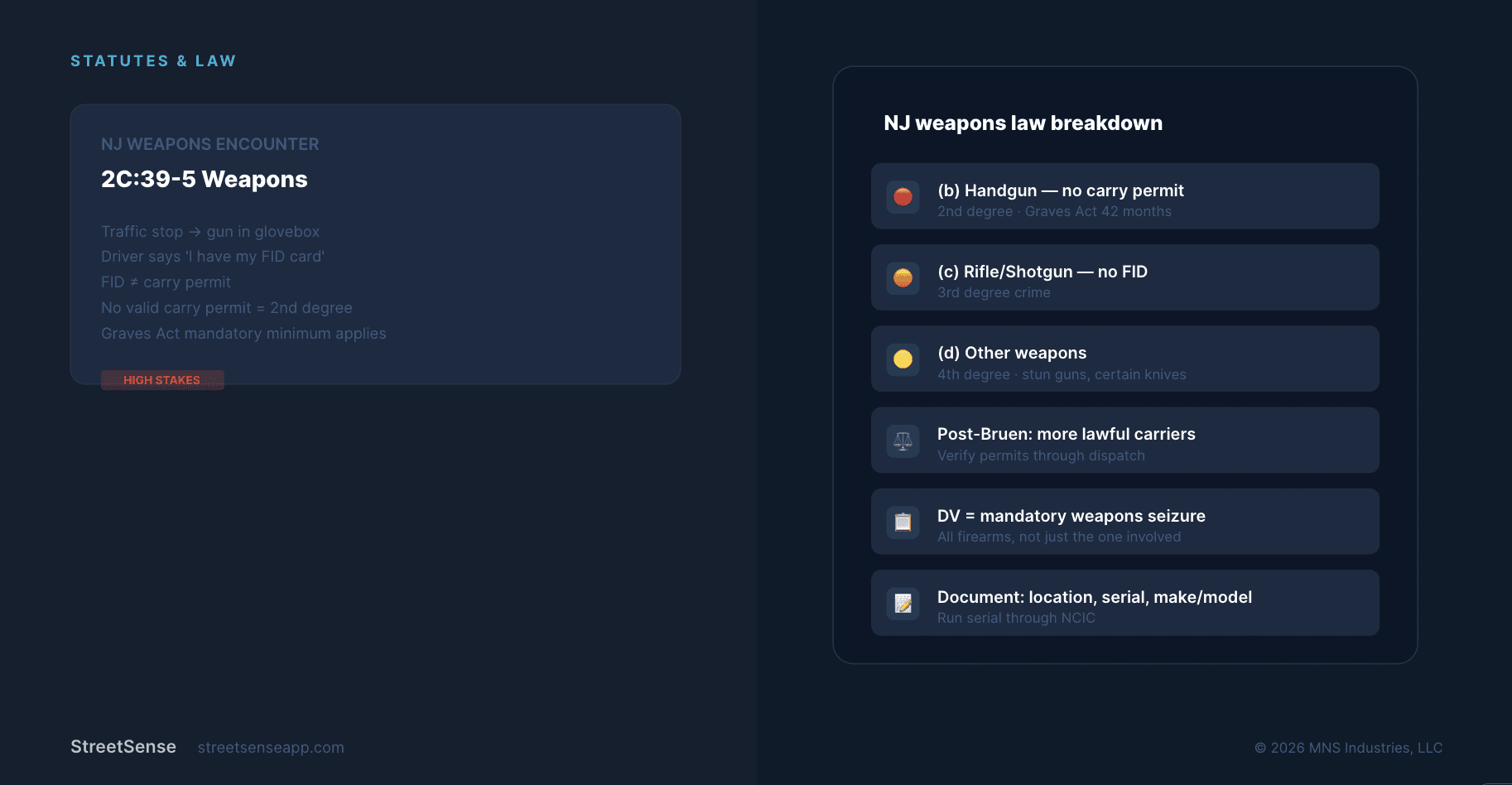
2C:39-5 is your unlawful possession statute. A person found with a handgun without a valid carry permit is looking at a second-degree charge. That’s the one you’ll encounter most often — the gun in the glovebox, the gun in the waistband, the gun found during a consent search. No valid carry permit means 2C:39-5(b), second degree.
2C:39-4 is possession for an unlawful purpose. This is when someone has a weapon with the intent to use it against another person. It elevates beyond mere possession. If the suspect had the gun and was heading to confront someone, making threats, or was just involved in a shooting — 2C:39-4 applies in addition to 2C:39-5.
2C:58-3 governs the permits themselves — who can get a Firearms Purchaser ID Card (FPID) and the process for permits to purchase handguns. You won’t charge this one often, but knowing it helps you understand what documentation is valid when someone claims they’re legal.
The Graves Act — Mandatory Minimums
The Graves Act is what makes NJ weapons charges hit differently. It imposes mandatory minimum sentences for certain firearms offenses — and it’s parole ineligibility, meaning the defendant must serve the minimum before being eligible for parole.
When you arrest someone for unlawful possession of a handgun, the Graves Act is already in play. You don’t need to “add” it as a charge — it’s a sentencing provision. But understanding it helps you explain to supervisors and prosecutors why these cases are treated as seriously as they are.
8,500+ statutes in your pocket.
Every statute, case, and directive — searchable and offline in the StreetSense app. Try free for 7 days.
Post-Bruen: What Changed with Carry Permits
After the Supreme Court’s NYSRPA v. Bruen decision in 2022, New Jersey had to overhaul its carry permit system. The old “justifiable need” standard — which effectively made NJ a no-issue state — was struck down. Now, applicants who meet the statutory requirements can obtain a carry permit without proving a specific threat.
For patrol, this means you will encounter more people lawfully carrying concealed handguns. Verify permits through dispatch. A valid NJ carry permit means they’re legal — treat it like a valid driver’s license for a traffic stop. No permit, or an expired permit, and you’re back to 2C:39-5.
Common Patrol Scenarios
Traffic stop, gun in the car: Ask if they have a carry permit. No permit — that’s 2C:39-5(b), second degree. Secure the weapon, arrest, and transport. If they have an FID card but no carry permit, the FID only covers transport to/from ranges and dealers under specific conditions — it does not authorize general carry.
DV call, firearms in the home: Under the Prevention of Domestic Violence Act, if you arrest the defendant or issue a TRO, you are required to seize any weapons in the home. This is not discretionary. Document every firearm seized on the receipt.
Certain persons with a weapon: 2C:39-7 covers “certain persons not to have weapons.” This includes convicted felons, anyone committed to a mental health facility, and certain DV offenders. If a prohibited person is in possession, it’s a second-degree charge on top of everything else.
What to Document
Weapons cases live or die on your report. Document where the weapon was found (exact location — “under the driver’s seat” not “in the car”), how it was found (plain view, consent search, search incident to arrest, Terry frisk), serial number, make, model, caliber, loaded or unloaded, and whether the defendant made any statements about the weapon. Run the serial through NCIC. A stolen gun adds a charge and tells a story.
The information provided on this blog is for general informational and educational purposes only and does not constitute legal advice. Statutes, case law, and agency directives are subject to change, amendment, and judicial interpretation at any time. This blog is published by MNS Industries, LLC, the developer of the StreetSense app. Content is written from a law enforcement perspective and is intended to support — not replace — department training, official policy, legal counsel, or prosecutorial guidance. Officers should always consult their department’s standard operating procedures, their county prosecutor’s office, and applicable Attorney General directives before making enforcement decisions. For corrections or questions: nick@mnsindustriesllc.com
© 2026 MNS Industries, LLC. All rights reserved.
Working New Jersey? See the full New Jersey police field reference — statutes, case law, and field guides, offline.