

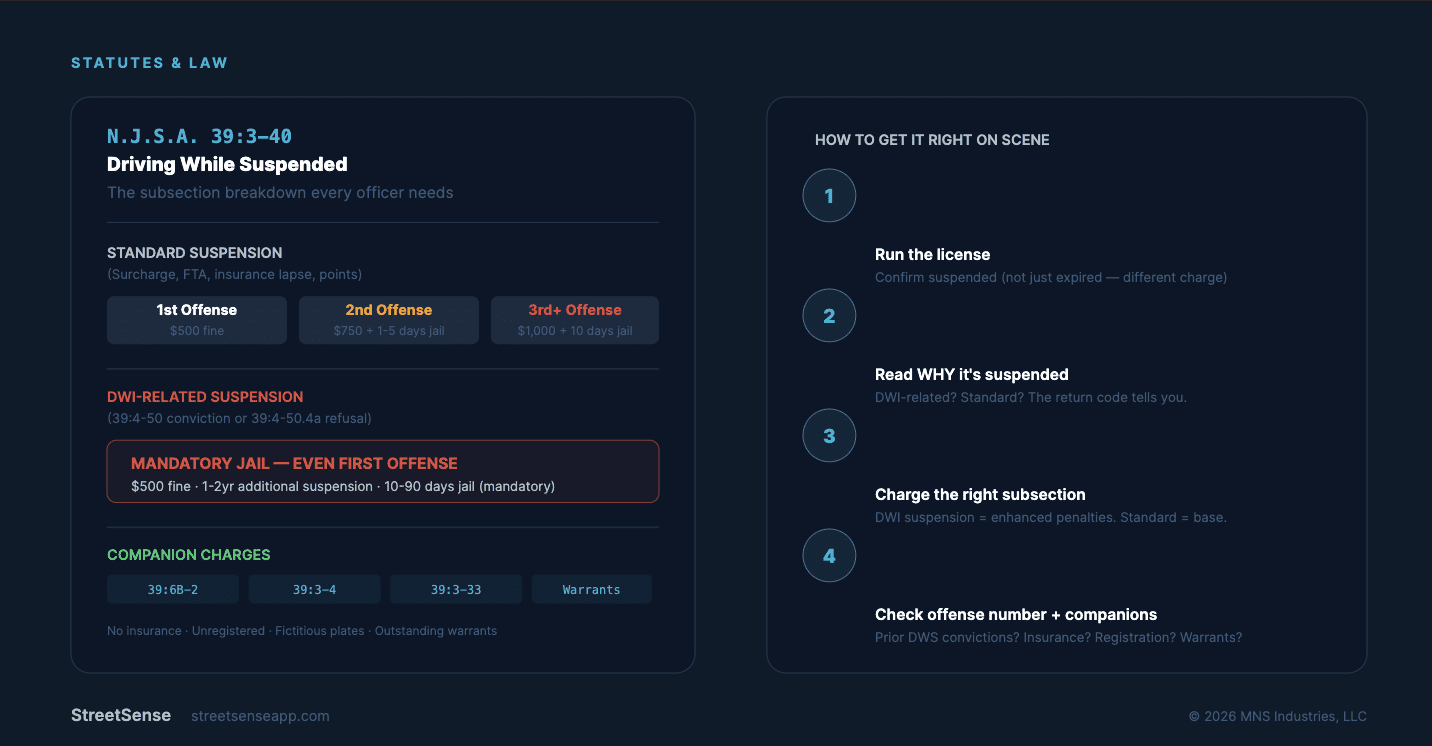
Driving While Suspended looks simple on the surface — the license is suspended, they’re driving, write the ticket. But the subsections, the penalty tiers, and the distinction between suspension types make this one of the most nuanced charges in Title 39.
Get it right and it’s straightforward. Get the subsection wrong and you’ve written a charge that doesn’t match the facts — which creates problems for the prosecutor and potentially for you during review.
The Base Statute: N.J.S.A. 39:3-40
At its core, 39:3-40 prohibits operating a motor vehicle while your license is suspended, revoked, or you’ve been prohibited from obtaining a license. That’s the broad stroke. The details live in the subsections and the penalty schedule.
Why the Reason for Suspension Matters
This is where most charging errors happen. NJ doesn’t treat all DWS offenses the same. The penalty you’re imposing depends on why the license was suspended in the first place. There are essentially two tracks:
Track 1: Standard suspension — surcharge non-payment, failure to appear, insurance lapse, points accumulation, administrative suspension. These are the most common and carry the standard penalty schedule.
Track 2: DWI-related suspension — if the underlying suspension was for a DWI conviction (39:4-50) or refusal (39:4-50.4a), the penalties are significantly harsher, including mandatory jail time even on a first offense.
The difference is massive. A first-offense standard DWS is a $500 fine and possible additional suspension — no mandatory jail. A first-offense DWI-related DWS carries mandatory jail time. If you write the standard charge when the suspension was DWI-related, you’ve undercharged. If you write the DWI-related charge when the suspension was for surcharge non-payment, you’ve overcharged. Both create problems.
How to Get It Right on Scene
When you run a license and it comes back suspended, the dispatch or MDT return should include the reason for suspension. Read it. Don’t just see “SUSPENDED” and start writing.
Step 1: Confirm the license is in fact suspended (not just expired — that’s a different charge under 39:3-10).
Step 2: Identify why it’s suspended. The return code or narrative will indicate the reason. Common reasons: surcharge non-payment, FTA (failure to appear), insurance lapse, DWI conviction, refusal conviction, points accumulation, child support.
Step 3: If the suspension is DWI-related (39:4-50 conviction or 39:4-50.4a refusal), charge the DWI-enhanced subsection. If it’s for any other reason, charge the standard subsection.
Step 4: Determine the offense number. Check the driver’s history for prior DWS convictions. First, second, and third+ offenses carry different penalties. Get the count right.
39:3-40 with full subsection breakdown and officer notes.
StreetSense walks you through the DWS subsections, penalty tiers, and companion charges. Study it once, reference it anytime.
Companion Charges: What Else to Check
DWS rarely travels alone. When someone is driving on a suspended license, there’s usually more going on. Here’s what experienced officers check:
Insurance — 39:6B-2: If their license is suspended, there’s a strong chance their insurance has lapsed too. Run the insurance and add the charge if it comes back negative. No insurance carries $300-$1,000 fine and a one-year mandatory suspension.
Registration — 39:3-4: Suspended drivers sometimes let their registration lapse as well, especially if the suspension was for surcharge non-payment (they’ve stopped dealing with MVC entirely). Check the registration status.
Fictitious plates/documents — 39:3-33: Some suspended drivers borrow plates from another vehicle to avoid detection. If the plates don’t match the vehicle, that’s a separate charge.
Warrant check: Drivers with suspended licenses often have outstanding warrants — frequently for the same FTA that caused the suspension in the first place. Always run the name.
The Suspension Cycle
Understanding why so many people drive on suspended licenses helps you understand the encounters you’re having. The most common suspension reasons in NJ are surcharge non-payment and failure to appear — not DWI. These are often people who got a ticket, couldn’t afford the fine, missed a court date, got hit with a surcharge they couldn’t pay, and then lost their license for non-payment. They still need to get to work, so they drive.
That doesn’t change the charge — the law is the law. But it gives you context for the encounter and helps you understand why DWS is one of the most common charges written in NJ. These aren’t all dangerous drivers. Many are people caught in an administrative spiral they can’t get out of.
NJ has implemented some reforms to address this — including amnesty programs for surcharge debt and the elimination of license suspensions for some non-driving offenses. But the basic DWS framework under 39:3-40 remains, and officers need to know it.
The Bottom Line
39:3-40 is not a complicated statute — but charging it correctly requires knowing why the license was suspended and what offense number you’re dealing with. The DWI-related distinction is the most important thing to get right because it’s the difference between a fine and mandatory jail time. Read the suspension reason before you write. Check the history for priors. Stack the companion charges that apply.
StreetSense includes 39:3-40 with the full subsection breakdown, penalty tiers by offense number, companion charge suggestions, and officer notes covering the DWI-related distinction. It’s the kind of statute worth reviewing until the subsections are second nature.
833 NJ statutes with the field notes that matter.
Companion charges, penalty tiers, subsection breakdowns — all offline, all searchable. Built for officers who want to get it right.
The information provided on this blog is for general informational and educational purposes only and does not constitute legal advice. Statutes, case law, and agency directives are subject to change, amendment, and judicial interpretation at any time. This blog is published by MNS Industries, LLC, the developer of the StreetSense app. Content is written from a law enforcement perspective and is intended to support — not replace — department training, official policy, legal counsel, or prosecutorial guidance. Officers should always consult their department’s standard operating procedures, their county prosecutor’s office, and applicable Attorney General directives before making enforcement decisions. For corrections or questions: nick@mnsindustriesllc.com© 2026 MNS Industries, LLC. All rights reserved.
Working New Jersey? See the full New Jersey police field reference — statutes, case law, and field guides, offline.