

If you asked most patrol officers what tools they carry every shift, they’d list the obvious: radio, weapon, vest, flashlight, cuffs, notebook. Maybe an MDT in the car. What almost nobody lists is a reference tool — something that puts the statutes, case law, and field procedures they’re supposed to know cold into a format they can actually access when it matters.
That’s the gap an FTO app fills. Not as a replacement for training or experience — as a supplement to it. The same way an FTO riding with you doesn’t do the work for you, but makes sure you’ve got the right framework before you act.
What “FTO App” Actually Means
The term comes from Field Training Officer — the experienced cop who rides with new officers during their probationary period. An FTO’s job isn’t to make decisions for the rookie. It’s to make sure the rookie has the right information, the right context, and the right thought process before making their own decisions.
An FTO app works the same way. It’s a reference tool that organizes legal information the way an officer actually thinks during a stop — not the way a law student studies for an exam. The difference matters more than you’d think.
How It’s Different From Googling a Statute
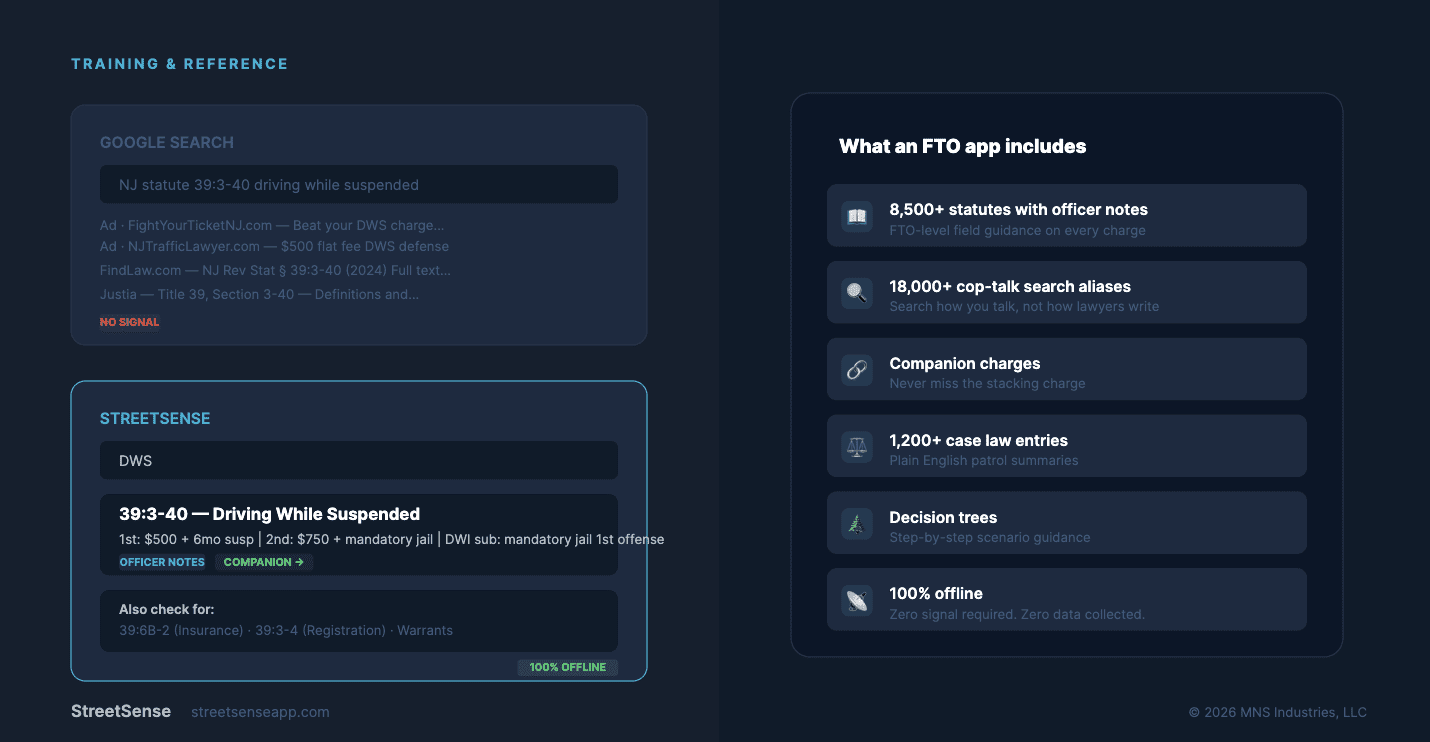
Every officer has Googled a statute number on the side of the road. And every officer knows the problems with that approach: you need signal, the results are written for defendants and defense attorneys, the information might be outdated, and you’re scrolling through ads and legal blog spam to find the actual text.
A purpose-built reference app solves all of that, but the real value isn’t just “it works offline.” It’s the layer of context that sits on top of the raw legal text.
When you look up 39:3-40 (Driving While Suspended) in a reference app built for officers, you don’t just get the statute text. You get the field notes: which subsection applies to DWI-related suspensions, what the mandatory jail triggers are, what companion charges to check (insurance, registration), and what the penalty breakdown looks like by offense number. That’s the kind of context an FTO would give you standing next to the car — and it’s the kind of context Google doesn’t provide.
The Core Features That Matter
Officer Notes: Every statute should come with annotations written from the officer’s perspective. Not legal analysis — practical field guidance. “This is what this statute actually means when you’re standing on the shoulder at 2am” is more useful than a paragraph of legislative intent.
Search Aliases: Officers don’t search for “N.J.S.A. 39:4-50” — they search for “DWI.” A good reference tool maps thousands of cop-talk terms to the statutes they refer to. Search “tint” and find the window tint statute. Search “DWS” and find driving while suspended. Search “Graves Act” and find the mandatory minimum provision. The app should speak your language.
Companion Charges: One of the most valuable things an FTO teaches a rookie is “when you see X, also check for Y.” Driving while suspended? Check insurance. Assault? Check weapons. Drug possession? Check paraphernalia. A reference tool that surfaces these connections saves you from tunnel vision on a single charge.
Decision Trees: Complex scenarios — DWI investigation, domestic violence response, use of force assessment — involve branching logic that’s hard to hold in your head under pressure. A decision tree walks you through the yes/no questions step by step. Not to replace your judgment, but to make sure you’re not skipping steps during training exercises or pre-shift review.
This is what StreetSense was built to do.
8,500+ statutes across 5 states with FTO-level officer notes, companion charges, search aliases, and decision trees. 100% offline.
Case Law in Plain English
This is the feature that separates a statute browser from a real field reference tool. Statutes tell you what the law says. Case law tells you how courts have interpreted it — and more importantly, what the boundaries of your authority actually are.
Terry v. Ohio defines your stop-and-frisk authority. Rodriguez v. United States limits how long you can extend a traffic stop. Miranda v. Arizona governs when you need to advise rights. These cases shape what you do every shift, but most officers learned them in the academy and haven’t revisited them since.
A good reference app includes case law written in plain English with a “what this means for patrol” section — not a law review article, but a practical summary of the holding and how it applies to field encounters. When you’re reviewing your authority before a shift or studying for a promotional exam, having that context at your fingertips matters.
Why Offline Isn’t a Feature — It’s the Foundation
Any reference tool that requires an internet connection is fundamentally unreliable for patrol work. You will be in locations without signal. You will need information in basements, rural stretches, parking garages, and dead zones. An app that works “most of the time” isn’t a tool you can depend on.
Offline capability means everything — every statute, every case, every directive, every decision tree — is downloaded to your device and available regardless of connectivity. No loading spinners, no “check your connection” errors. The information is there when you need it, period.
Who It’s For
If you’re a rookie in your FTO phase, a tool like this gives you a second source of confirmation when your FTO asks “what would you charge here?” If you’re a veteran officer, it’s the quick reference you use when you encounter a statute you don’t write every day. If you’re an FTO yourself, it’s a training aid you can point your recruits to when they need to study.
It’s not a replacement for knowing the law. It’s a supplement that makes sure you have the right information organized the right way when you need to reference it.
See what an FTO app looks like.
StreetSense covers NJ, PA, NY, MD, and CT. Download it and explore with a 7-day free trial.
The information provided on this blog is for general informational and educational purposes only and does not constitute legal advice. Statutes, case law, and agency directives are subject to change, amendment, and judicial interpretation at any time. This blog is published by MNS Industries, LLC, the developer of the StreetSense app. Content is written from a law enforcement perspective and is intended to support — not replace — department training, official policy, legal counsel, or prosecutorial guidance. Officers should always consult their department’s standard operating procedures, their county prosecutor’s office, and applicable Attorney General directives before making enforcement decisions. For corrections or questions: nick@mnsindustriesllc.com© 2026 MNS Industries, LLC. All rights reserved.