

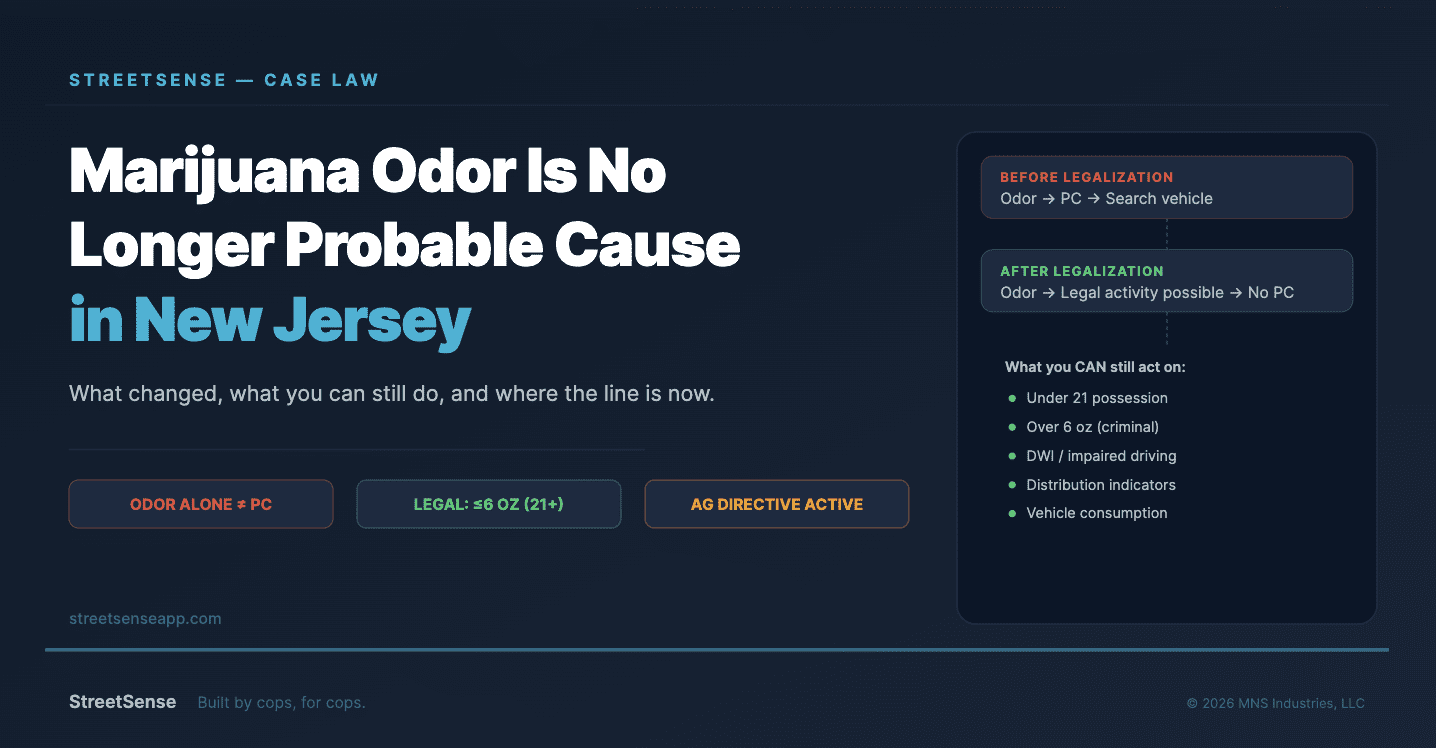
If you’re working patrol in New Jersey in 2026 and you’re still treating the smell of marijuana as probable cause for a search, you need to read this. The legal landscape shifted hard after legalization, and the courts have made it clear: odor alone is no longer enough.
Here’s what changed, what you can still do, and where the line is now drawn.
What Happened: Cannabis Legalization in NJ
In 2021, New Jersey legalized recreational cannabis for adults 21 and older. Under the New Jersey Cannabis Regulatory, Enforcement Assistance, and Marketplace Modernization Act (CREAMMA), adults can legally possess up to 6 ounces of cannabis. That single change rewrote decades of patrol practice overnight.
Before legalization, the smell of marijuana was well-established as probable cause for a vehicle search. Courts had consistently held that the distinctive odor of cannabis, detected by a trained officer, provided sufficient basis to believe a crime was being committed. That logic was straightforward: marijuana was illegal, so smelling it meant a crime was likely occurring.
That logic no longer holds.
The Legal Shift: Why Odor Alone Fails
The reasoning is simple once you think about it. If possessing up to 6 ounces is legal for adults 21+, then the mere smell of marijuana no longer establishes that a crime is being committed. The odor is equally consistent with lawful possession as it is with unlawful activity. And probable cause requires a fair probability that criminal activity is afoot — not just that something exists.
This tracks with how other states have handled the same issue. Massachusetts led the way with Commonwealth v. Cruz (2020), where their Supreme Judicial Court held that the odor of marijuana could not justify a search after decriminalization. NJ courts have followed the same trajectory.
The AG Directive That Changed Enforcement
In addition to the case law development, the NJ Attorney General issued guidance directing law enforcement on how to handle cannabis encounters post-legalization. The directive makes clear that officers should not use the odor of marijuana as the sole basis for a search, and that the mere observation of legal quantities of cannabis does not constitute criminal activity.
This isn’t optional guidance. AG directives carry the force of policy for every law enforcement officer in New Jersey. If you conduct a search based solely on marijuana odor and it gets challenged, you’re going to have a hard time justifying it — and your department is going to have a hard time backing you up.
What You CAN Still Do
Legalization didn’t eliminate every cannabis-related enforcement tool. Here’s what remains lawful and actionable on patrol:
Underage possession is still illegal. If you have reason to believe the occupant is under 21, cannabis possession remains a violation. The odor combined with indicators of underage possession (visible ID showing under 21, statements from the individual, school parking lot context) can still support further investigation.
Over 6 ounces is still illegal. If you can observe or have articulable facts suggesting possession beyond the legal limit, that remains a criminal matter. But you need more than odor — visible large quantities, statements, packaging consistent with distribution, or other indicators.
DWI under the influence of cannabis is still illegal. If you observe impaired driving and suspect cannabis intoxication, you still have the full DWI investigation framework available to you. The odor of cannabis in a vehicle combined with driving behavior consistent with impairment is a different situation than odor alone during a routine stop. You’re not searching for cannabis — you’re investigating impaired driving.
Distribution and unlicensed sales are still illegal. Scales, baggies, large amounts of cash, multiple phones, and other indicators of distribution activity remain relevant. But those indicators need to be observed independently — the smell alone doesn’t get you there.
Open container / consumption in a vehicle. Using cannabis in a motor vehicle is still unlawful under NJ law, similar to open container laws for alcohol. If you observe active consumption (smoking, vaping) in a vehicle, that’s an independent violation regardless of the amount possessed.
Every NJ cannabis statute and AG directive in one place.
StreetSense includes all NJ AG directives on cannabis enforcement, plus the statutes you need. Reference before your shift, not during a judgment call.
Practical Scenarios: How This Plays Out on Patrol
Scenario 1: Routine traffic stop, strong odor of marijuana from the vehicle. You can note the odor in your report. You cannot use it alone to search the vehicle. If the driver is cooperative, you issue whatever citation prompted the stop and move on. If you observe other indicators (slurred speech, bloodshot eyes, impaired motor function), you may have a DWI investigation — but that’s based on impairment, not possession.
Scenario 2: Traffic stop, odor of marijuana, driver appears to be a teenager. Now you have odor plus an articulable basis to believe the person may be under 21. You can ask for ID. If they are in fact under 21, underage possession becomes the issue. Tread carefully — verify the age before acting on the cannabis specifically.
Scenario 3: Traffic stop, you see a large clear bag of marijuana on the passenger seat that appears well over 6 ounces. Visible contraband in plain view remains an exception. If you can articulate that the quantity you observed in plain view appeared to exceed the legal limit, you have a basis for further action. But “it looked like a lot” is vague — be specific about what you saw and why you believed it exceeded 6 ounces.
Scenario 4: Pedestrian encounter, person is smoking a joint on the sidewalk. Public consumption may be restricted depending on local ordinances and the specific location. In a motor vehicle, consumption is clearly prohibited. On foot, check your municipality’s ordinances — some have enacted restrictions on public consumption while others have not.
The Bottom Line
The smell of marijuana is no longer your golden ticket to a vehicle search in New Jersey. That era is over. But cannabis enforcement isn’t gone — it’s just narrower. Underage possession, over-limit possession, DWI, distribution, and vehicle consumption are all still enforceable. The key is having articulable facts beyond just the odor.
Know the current legal framework before you’re standing on the side of the road making a decision. Study it during downtime, not under pressure. The AG directive, the controlling case law, and every relevant statute are all available in StreetSense — searchable, offline, and written in plain English.
All 42 NJ AG directives. Searchable. Offline.
Including cannabis enforcement guidance, use of force, body cameras, and pursuit policy. Study up before your shift.
The information provided on this blog is for general informational and educational purposes only and does not constitute legal advice. Statutes, case law, and agency directives are subject to change, amendment, and judicial interpretation at any time. This blog is published by MNS Industries, LLC, the developer of the StreetSense app. Content is written from a law enforcement perspective and is intended to support — not replace — department training, official policy, legal counsel, or prosecutorial guidance. Officers should always consult their department’s standard operating procedures, their county prosecutor’s office, and applicable Attorney General directives before making enforcement decisions. For corrections or questions: nick@mnsindustriesllc.com© 2026 MNS Industries, LLC. All rights reserved.
Working New Jersey? See the full New Jersey police field reference — statutes, case law, and field guides, offline.